
Sushi Cucumber Boats

Crunchy Cucumber Boats With Ahi Tuna, Sushi Rice, and All the Good Toppings
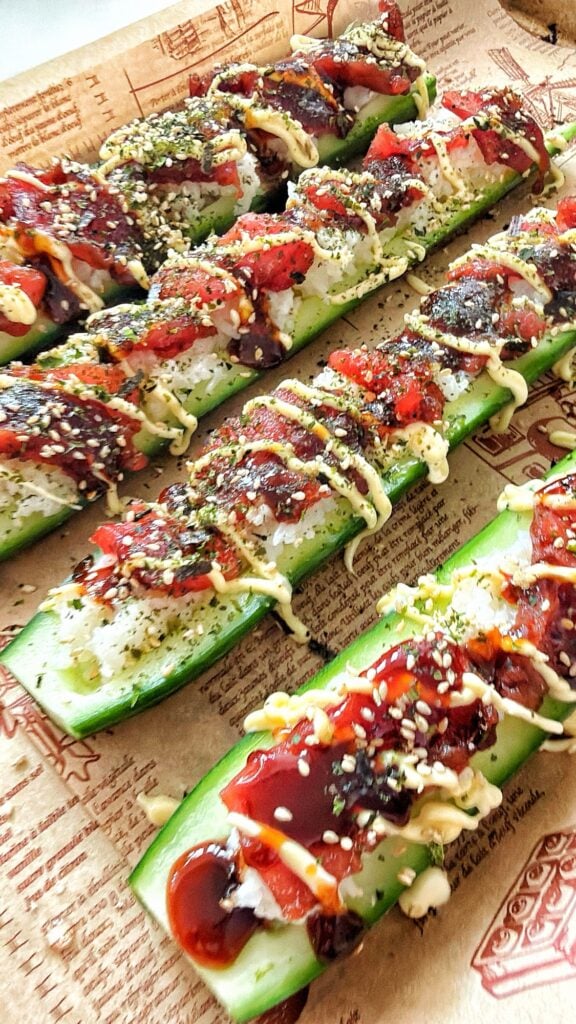
These sushi cucumber boats have seasoned sushi rice, thinly sliced ahi tuna, creamy Japanese mayonnaise, and a sweet and savory sauce tucked into crisp cucumber halves. A sprinkle of furikake and some pickled hot honey jalapeños finish them off. Serve them as a fun dinner for two or cut them into smaller pieces for an appetizer.
An Instagram Idea That Made It Into My Kitchen
I saw a video on Instagram of someone making sushi cucumber boats with salmon. I loved the idea, but salmon is usually not my thing. Once in a great while I will have smoked salmon on a bagel, but for these, I wanted tuna.
When I tried to find the written recipe, there were a few too many things to sign up for, so I decided to work out my own version. After looking around, I realized cucumber sushi boats are one of those ideas that lots of people have their own take on, kind of like meatloaf. The video inspired me to try them, and this is how I made mine with the ingredients and flavors I enjoy.
That is also something I want to do more of: take an idea we see online, bring it into a real kitchen with my own twist, and see how it works. These worked, and they gave me a chance to share a few basic kitchen skills along the way.
Before You Jump to the Recipe
- Two long seedless cucumbers make four boats.
- You only need about 1 to 1½ cups of cooked sushi rice for the boats. The instructions below for two-cup dry-rice makes extra, which you can use as a side or promptly refrigerate or freeze for a future fried rice or other dish.
- Cool the seasoned rice before adding the tuna.
- Scoop a shallow channel down each cucumber half, leaving enough cucumber to hold everything together.
- Peel or trim a thin strip from the underside so the boats sit flat.
- Slightly frozen tuna is easier to slice thinly, but it should be pliable enough to cut without forcing the knife.
- Start with a tiny pinch of Chinese five-spice powder. It is strong.
- Keep the tuna refrigerated while preparing everything else.
- Add the sauces and toppings just before serving.
Ingredients You’ll Need
- 2 long seedless cucumbers, such as English cucumbers
- Approximately 1 to 1½ cups prepared sushi rice, cooled; see recipe card below
- 1 larger ahi tuna steak, or enough to top four boats; approximately 4 to 6 ounces is a starting estimate
- Approximately 1 to 2 teaspoons soy sauce, adjusted to taste
- A tiny pinch Chinese five-spice powder, up to 1/8 teaspoon, optional
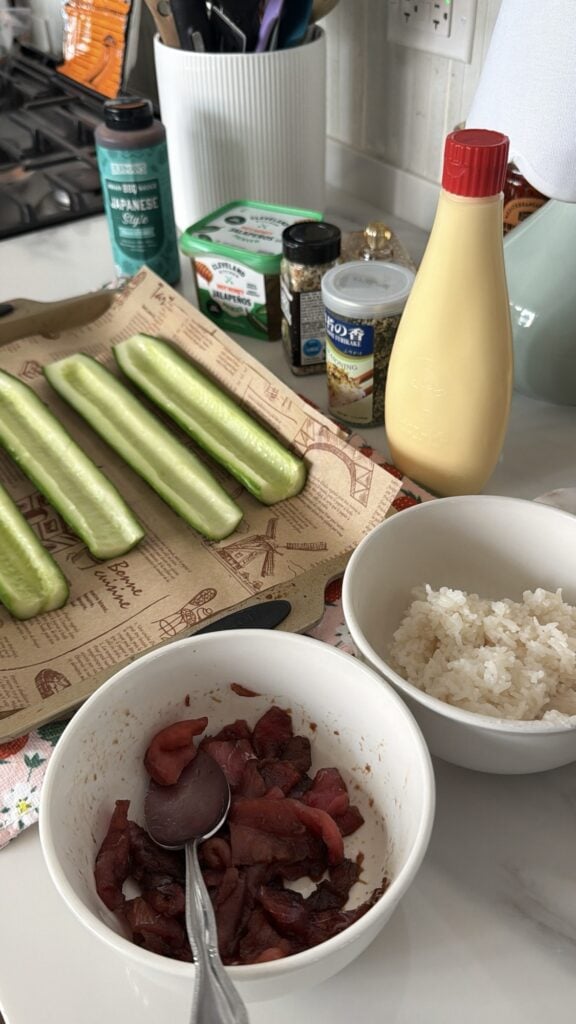
- Approximately 2 tablespoons Japanese mayonnaise, such as Kewpie, or the substitute below
- Approximately 1 to 2 teaspoons furikake, to taste
- Approximately 1 to 2 tablespoons Japanese barbecue sauce or ready-to-use teriyaki sauce
- Pickled hot honey jalapeños, to taste
- Finely chopped chives or 1 to 2 thinly sliced green onions, optional
The sauce and topping quantities are starting estimates for writing this down. I made mine with a few shakes, drizzles, and sprinkles. You can use more or less depending on how generously you fill your boats.
The Cucumbers
I used two seedless cucumbers. Seedless cucumbers still have a soft center, and that is what you scrape out with a teaspoon to make room for the filling.
I peeled away some of the skin in strips, leaving some behind for color and texture. Then I halved the cucumbers lengthwise and scooped a channel down the middle. Leave the ends and a sturdy bottom intact so the filling has somewhere to sit.
My little trick is to peel a slightly deeper strip along the underside of each half. That creates a flat spot so the cucumber does not roll around. You can also carefully trim off a very thin slice with a knife. You are just making a base, so do not cut through to the hollow center.
The Ahi Tuna I Use
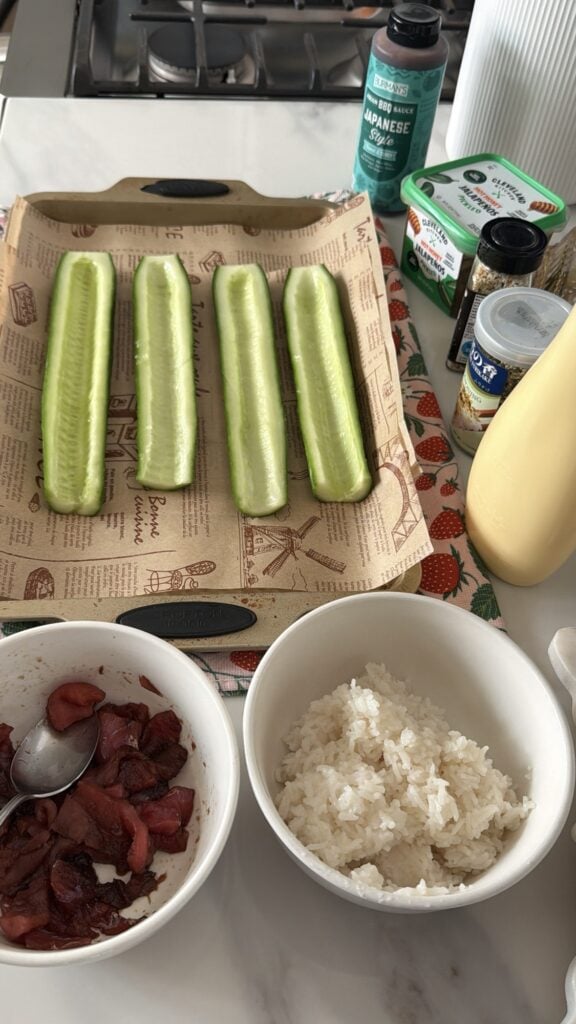
I buy frozen ahi tuna from Aldi. The packages I buy usually have a few pieces, and I used one of the larger pieces for these boats. Use enough to cover your rice, whether that means one steak or a little more.
For the raw version, use tuna that the supplier specifically identifies as suitable for raw consumption and follow its handling directions. Check the package you actually buy, because packaging and preparation instructions can change. If it says to cook it, cook it.
What Does “Sushi Grade” Actually Mean?
“Sushi grade” and “sushi quality” are sales descriptions, rather than a standardized FDA grade or certification. They can tell you how a seller intends the fish to be used, but those words alone do not explain how the fish was handled.
Freezing is one part of parasite control for certain fish. The FDA Food Code lists specific combinations, including -4°F or below for seven days; -31°F or below until solid and then held at that temperature for 15 hours; or -31°F until solid followed by storage at -4°F or below for 24 hours. Certain tuna species, including yellowfin and bigeye, are exempt from these parasite-destruction freezing requirements. That exemption does not mean the fish is free of every food safety risk.
I would not say that every frozen Aldi tuna steak is automatically safe raw or that a particular package has been frozen for a verified amount of time. Use the product’s actual directions and supplier guidance. Freezing does not eliminate all harmful germs, and soy sauce does not make raw fish safe. Fully cooked tuna or cooked shrimp are easy alternatives. People who are pregnant, young children, older adults, and people with weakened immune systems should use a fully cooked filling.
A Little Chinese Five-Spice Goes a Long Way
Chinese five-spice powder is a warm, fragrant blend commonly made with star anise, cloves, cinnamon or cassia, fennel seeds, and Sichuan peppercorns. The exact blend varies. It adds something a little unexpected to the tuna, but it can take over quickly.
Start with a tiny pinch, especially if you are using just one tuna steak. You do not need more than 1/8 teaspoon for this amount, and you may prefer much less. You can leave it out entirely.
Look for it in the spice section or international foods aisle, or at an Asian grocery store. If you already have the ground spices, a simple starting blend is equal parts of the five listed above. Mix a small amount and use only a pinch in this recipe. There is no need to buy five separate spices just for these boats.
Japanese Mayonnaise and an Easy Substitute
I used Kewpie, the Japanese mayonnaise in the familiar squeeze bottle. Japanese-style mayonnaise is rich, smooth, and tangy; Kewpie’s signature mayonnaise uses egg yolks for its richness. It is more than simply sweet mayonnaise.
If you have regular mayonnaise, start with 2 tablespoons mayonnaise, ¼ teaspoon sugar, and ½ teaspoon unseasoned rice vinegar or white wine vinegar. Stir well, then add water a few drops at a time until it drizzles. Taste before adding more sugar. This is a convenient substitute for the topping rather than an exact copy of Kewpie.
If your Kewpie is too thick to drizzle, thin a small portion with a few drops of water. A small food storage bag with a tiny corner snipped off makes an easy squeeze bag.
What Is Furikake?
Furikake is a Japanese seasoning often sprinkled over rice. A simple version combines sesame seeds and dried seaweed, while other varieties include ingredients such as dried fish, salt, or sugar.
Look in the international foods aisle, at an Asian grocery store, or online, including Amazon. Read the label if you are avoiding fish, sesame, or other allergens, because blends vary.
For a quick substitute, combine 1 tablespoon toasted sesame seeds with 1 tablespoon finely crumbled roasted nori, then add a small pinch of salt if needed. Sprinkle on as much as you like. Sesame seeds alone also add a nice finish if that is what you have.
The Sauce and Those Jalapeños
I found a Japanese barbecue sauce at Aldi and used that for my final drizzle. A ready-to-use teriyaki sauce works, too. Pick a sauce meant for serving, or follow the label if it needs cooking first.
Start lightly. There is already soy sauce on the tuna and seasoning in the rice, so you can always add another drizzle after tasting.
The pickled hot honey jalapeños were my finishing touch. I have been obsessed with these, and I love the sweet heat with the creamy mayonnaise and cold cucumber. Drain them before adding so their liquid does not run all over the boats. Regular pickled jalapeños work, or leave them off if you do not want heat.
A Basic Skill: Making Sushi Rice in the Instant Pot
Use Japanese short-grain white rice labeled for sushi. It has the texture you want for this filling. Brown rice and long-grain rice need different cooking instructions.
For the two-cup batch, rinse 2 standard measuring cups of dry rice in cold water until the water is mostly clear. Drain well, then put it into the Instant Pot with 2 cups water. Do not use the smaller rice scoop that comes with some cookers for these measurements.
Secure the lid, set the valve to Sealing if your model requires it, and select High Pressure for 4 minutes. After cooking, let the pressure release naturally for 10 minutes, then carefully release any remaining pressure according to your model’s directions. The four minutes is pressure-cooking time; the pot also needs time to come to pressure.
While it cooks, gently warm ¼ cup unseasoned rice vinegar, 2 tablespoons sugar, and 1 teaspoon fine salt, just until dissolved. Fold this mixture into the hot cooked rice. The seasoning goes in after cooking.
Spread the rice in a shallow dish and let the portion for your boats cool until it is no longer warm. Fold gently rather than vigorously stirring and mashing the grains. Refrigerate extra rice promptly in a shallow container; do not leave the whole batch sitting out while you work.
No Rice Vinegar? Use What You Have
For this two-cup dry-rice batch, substitute 3 tablespoons white wine vinegar plus 1 tablespoon water for the ¼ cup rice vinegar. Keep the 2 tablespoons sugar and 1 teaspoon salt. Warm until dissolved and fold into the hot rice. This is a practical flavor substitute; sugar balances the taste but does not remove acidity.
Apple cider vinegar can work in the same mixture, although it brings a fruitier flavor. White wine vinegar is my first choice of those substitutes for a milder result.
Check whether your rice vinegar says seasoned or unseasoned. Seasoned rice vinegar already contains sugar and salt. If that is what you have, start with the vinegar alone and taste the seasoned rice before adding either.
How to Make Sushi Cucumber Boats
Make and Cool the Rice First
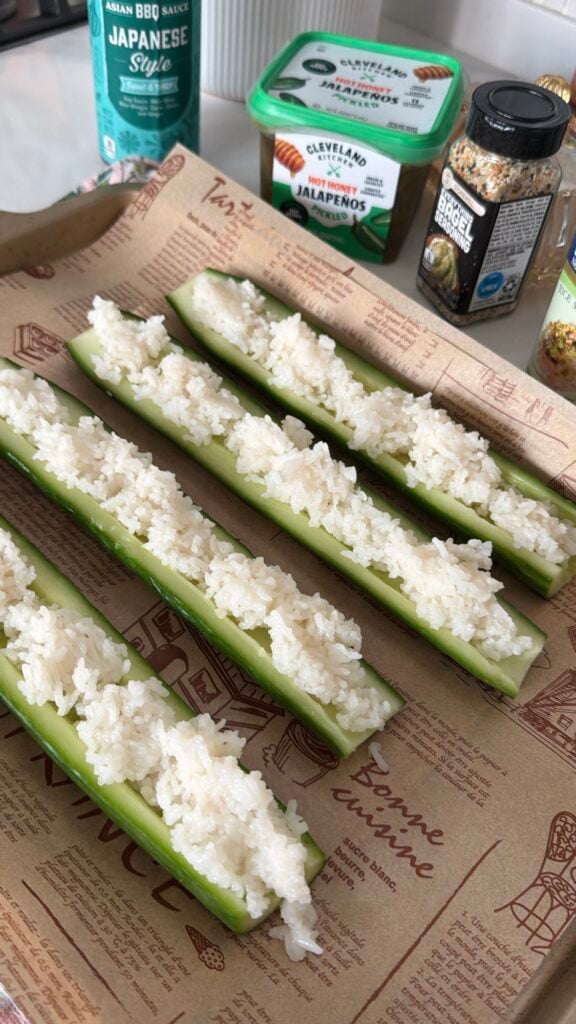
Prepare the sushi rice using the instructions in the recipe card below. You will need approximately 1 to 1½ cups cooked rice for four boats, depending on the size of the cucumbers and how much you scoop out. Keep the rice layer shallow enough to leave room for the tuna.
Prepare the Cucumbers
Wash and dry the cucumbers, peel them in strips, and cut them lengthwise. Use a teaspoon to scrape out the soft centers. Make a flat base on the underside and pat the channels dry with a clean paper towel.
Thinly Slice and Season the Tuna
Thaw the tuna in the refrigerator according to its package directions. For vacuum-packed fish, remove it from the reduced-oxygen packaging before refrigerator thawing unless the label specifically provides otherwise.
I find it easier to make thin slices while the center is still slightly icy. Use a sharp knife and a stable cutting board. If the fish is too hard to slice easily, let it thaw a little longer in the refrigerator.
Thinly slice across the grain and put the tuna in a bowl with a couple of shakes of soy sauce and the tiny pinch of five-spice powder. Add finely chopped chives or green onions if you like. Toss gently and refrigerate for about 5 to 10 minutes while you finish getting ready. This is a quick seasoning step, not a long marinade.
Fill, Drizzle, and Sprinkle
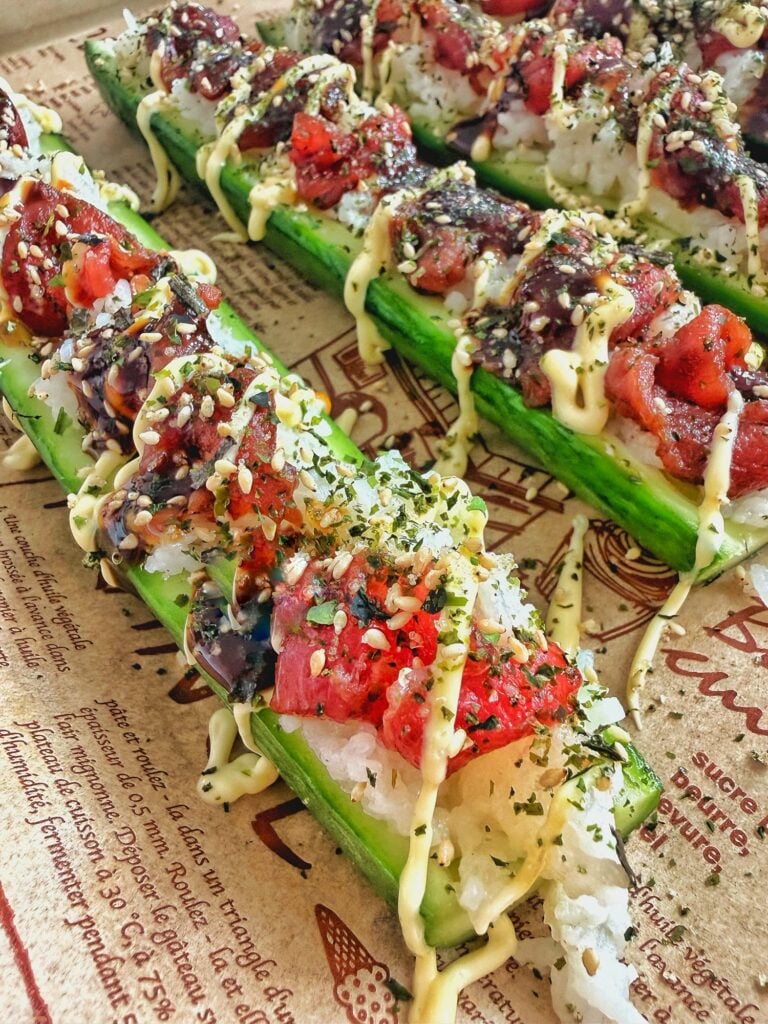
Spoon the cooled rice into the cucumber channels. Arrange the tuna over the rice, leaving excess marinade in the bowl.
Drizzle with mayonnaise, sprinkle with furikake, and add a little Japanese barbecue or teriyaki sauce. Top with drained pickled hot honey jalapeños and extra chives or green onions, if using.
Slice for an Appetizer
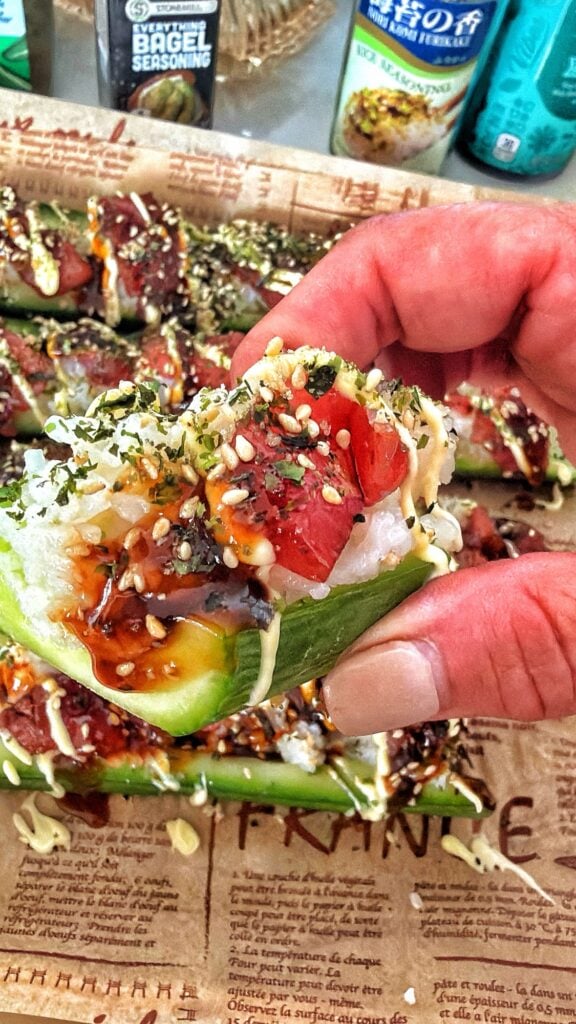
You can serve the cucumber halves as boats, or cut them crosswise into pieces about two inches long, like I did. Hold each boat gently and use a sharp knife so you do not push the filling out.
They are a little messy in the best way. Put out napkins and enjoy them right after assembling for the best crunch.
A Good Recipe for Building Kitchen Confidence
You do not need to know how to roll sushi to make these. You are practicing a few useful skills: rinsing and cooking rice, balancing a vinegar seasoning, making a vegetable sit flat on a cutting board, and using a little seasoning before deciding whether you need more.
Start with the rice and cucumbers if raw fish feels like too much for your first try. Fully cooked shrimp, flaked cooked tuna, or ready-to-eat imitation crab can go right on top. Read the package directions for whichever filling you choose.
Once you understand the basic assembly, you can make these the way you like them.
Make Ahead and Storage
These are best assembled just before eating. You can prepare the cucumbers earlier in the day and refrigerate them in a covered container. Keep the tuna separate, refrigerated at 40°F or below, and slice close to serving.
Cool extra cooked rice promptly in a shallow container and refrigerate within two hours of cooking. Use refrigerated rice within three to four days, or freeze it in portions. The vinegar seasoning here is for flavor; it does not make the rice safe to store on the counter.
Plan on eating the raw-tuna boats immediately after making them. For a party, keep them chilled and bring out small batches. Count all preparation and serving time toward a maximum of two hours out of refrigeration, or one hour above 90°F.
Frequently Asked Questions
Do I need all of the rice from the two-cup batch?
No. Two cups of dry rice make approximately 5 to 6 cups cooked, depending on the rice. The boats use about 1 to 1½ cups. Save the extra separately for bowls or another meal.
Can I leave out the five-spice powder?
Absolutely. The tuna still gets flavor from the soy sauce and toppings.
Can I make them without raw fish?
Yes. Fully cooked shrimp, cooked tuna, or ready-to-eat imitation crab work well. Cook fish to 145°F if using a fully cooked fish filling, then cool it before assembly.
Do I have to buy all of the specialty toppings?
No. Use the mayonnaise substitute, toasted sesame seeds, and a ready-to-use teriyaki sauce you already enjoy. The extra toppings are ways to customize them.
Why are my boats watery?
Cucumbers naturally release moisture. Pat the hollowed centers dry, drain the jalapeños, leave excess tuna marinade behind, and assemble close to serving.
More Delicious Cucumber Recipes
Instant Pot Sushi Rice Method Included in Card
Sushi Cucumber Boats Recipe
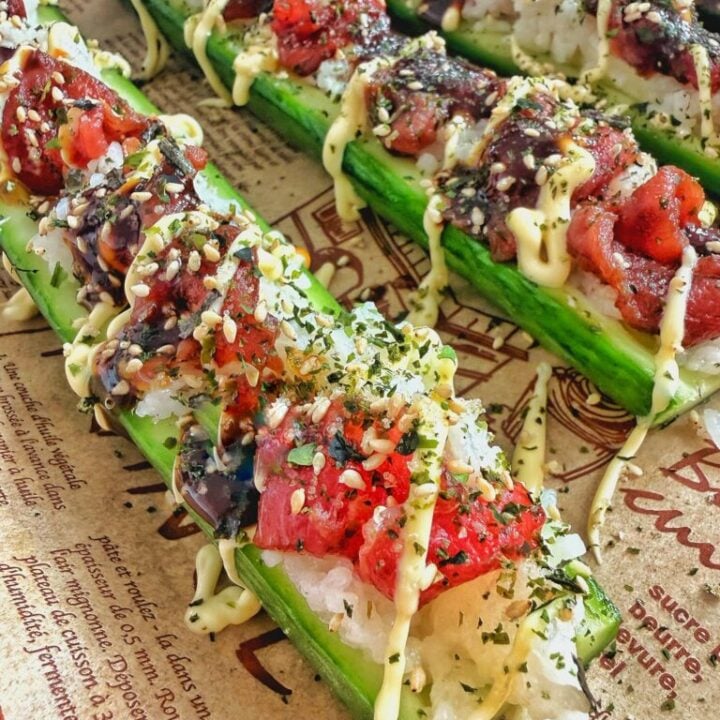
Crisp cucumber boats filled with seasoned sushi rice and thinly sliced ahi tuna, finished with Japanese mayonnaise, furikake, sweet and savory sauce, and pickled hot honey jalapeños. Also included are instructions for how to make short-grain white rice cooked in the Instant Pot, then gently seasoned with vinegar, sugar, and salt for the sushi boats, sushi bowls, and other homemade sushi-inspired meals.
Ingredients
FOR THE INSTANT POT SUSHI RICE
- 2 cups Japanese short-grain white sushi rice, measured dry with a standard measuring cup
- 2 cups water
- ¼ cup unseasoned rice vinegar
- 2 tablespoons granulated sugar
- 1 teaspoon fine salt
FOR THE SUSHI CUCUMBER BOATS
- 2 long seedless cucumbers
- 1 to 1½ cups cooked, seasoned sushi rice, cooled
- Approximately 4 to 6 ounces ahi tuna suitable for raw consumption, or enough to cover the boats
- 1 to 2 teaspoons soy sauce, to taste
- Tiny pinch Chinese five-spice powder, up to 1/8 teaspoon, optional
- 2 tablespoons Japanese mayonnaise, approximately
- 1 to 2 teaspoons furikake, to taste
- 1 to 2 tablespoons ready-to-use Japanese barbecue sauce or teriyaki sauce
- Pickled hot honey jalapeños, drained, to taste
- Chopped chives or 1 to 2 thinly sliced green onions, optional
Instructions
Preparing the Rice
- Rinse the rice in several changes of cold water until the water is mostly clear. Drain thoroughly. Do not soak for this method.
- Add the drained rice and 2 cups fresh water to the Instant Pot. Level the rice so it is covered by the water.
- Secure the lid and set the valve to Sealing if required. Select Pressure Cook or Manual, High Pressure, for 4 minutes. Turn off Keep Warm.
- When cooking ends, allow a 10-minute natural pressure release. Carefully release any remaining pressure according to your model’s instructions. Open only after the pressure indicator has dropped.
- Meanwhile, combine the vinegar, sugar, and salt in a microwave-safe bowl. Warm in short bursts, stirring, just until dissolved; do not boil.
- Transfer the cooked rice to a wide nonreactive bowl or shallow dish. Drizzle with the seasoning and gently fold with a rice paddle or spatula without mashing.
- Spread out the portion needed for the boats and cool until no longer warm before adding raw tuna. Refrigerate unused rice promptly in shallow containers, within two hours of cooking.
Assembling the Sushi Boats
- Cool the portion of the rice you need before assembling. Refrigerate extra rice promptly.
- Wash and dry the cucumbers. Peel away strips of skin, leaving some for color and texture. Halve lengthwise to make four boats.
- Use a teaspoon to scoop a shallow channel down each center, leaving the ends and a sturdy bottom intact. Peel or carefully trim a thin strip from each underside so it sits flat. Pat the channels dry.
- Following package directions, thaw suitable tuna in the refrigerator until pliable but still slightly icy for easier slicing. Remove vacuum packaging before refrigerator thawing unless the label specifically directs otherwise. Slice thinly across the grain.
- Gently toss the tuna with soy sauce and the optional five-spice powder. Add some chives or green onions if desired. Refrigerate for 5 to 10 minutes while preparing to assemble.
- Divide the cooled rice among the four cucumber channels. Top with tuna, leaving excess marinade behind.
- Drizzle with mayonnaise, sprinkle with furikake, and drizzle with Japanese barbecue or teriyaki sauce. Add drained jalapeños and any remaining chives or green onions.
- Serve immediately as whole boats, or carefully slice crosswise into approximately two-inch pieces. Keep chilled until serving.