
Bell’s Seasoning Stuffing

A Buttery, Custard-Style Holiday Stuffing With Crispy Edges and a Soft, Fluffy Center
This Bell’s Seasoning Stuffing is unlike any of my other stuffing recipes. It starts with simple white bread that is dried overnight, then soaked with buttery celery and onions, rich chicken or turkey broth, Bell’s Seasoning, and just a splash of soy sauce. Eggs and heavy cream give the inside an almost soufflé-like, custardy texture while plenty of butter helps create those crispy golden bits across the top and around the edges.
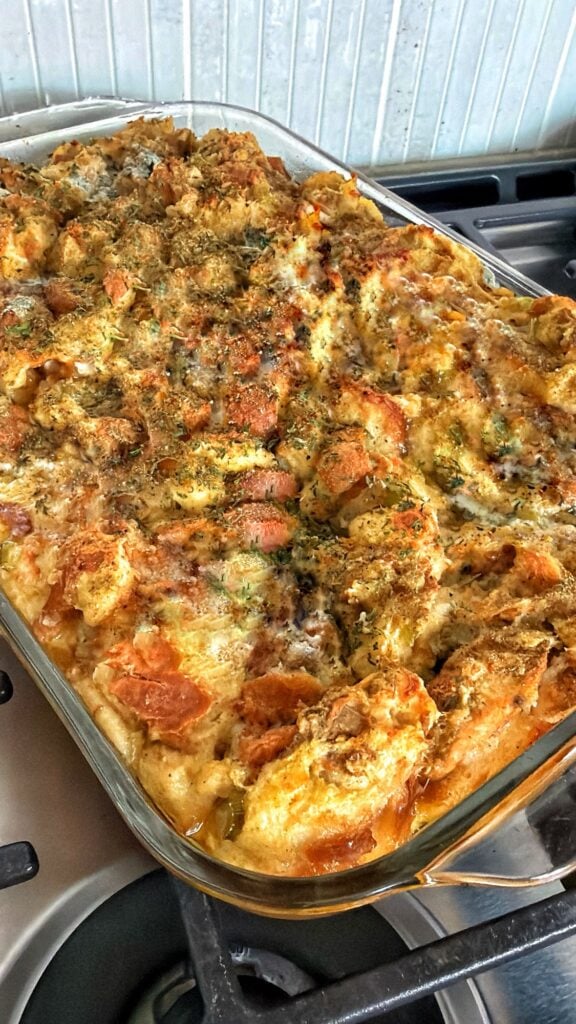
This stuffing runs just slightly on the sweeter side thanks to the soft white bread and sweet onions, but it is still wonderfully savory. It would be fantastic alongside Thanksgiving turkey, roasted chicken, pork roast, or even a simple holiday ham.
Before You Jump to the Recipe
Before you head straight to the recipe card, there are a few things worth reading because the amount of liquid your bread needs can vary. Take a look at How Wet Should Stuffing Be Before Baking?, especially the photo showing exactly how mine looked before it went into the oven. You may also want to read What Is Bell’s Seasoning? if this little yellow box is new to you, Why I Add Heavy Cream and Eggs to understand the custardy texture, and How to Add Sausage if you want to turn this into an even heartier holiday side dish.
What Is Bell’s Seasoning?
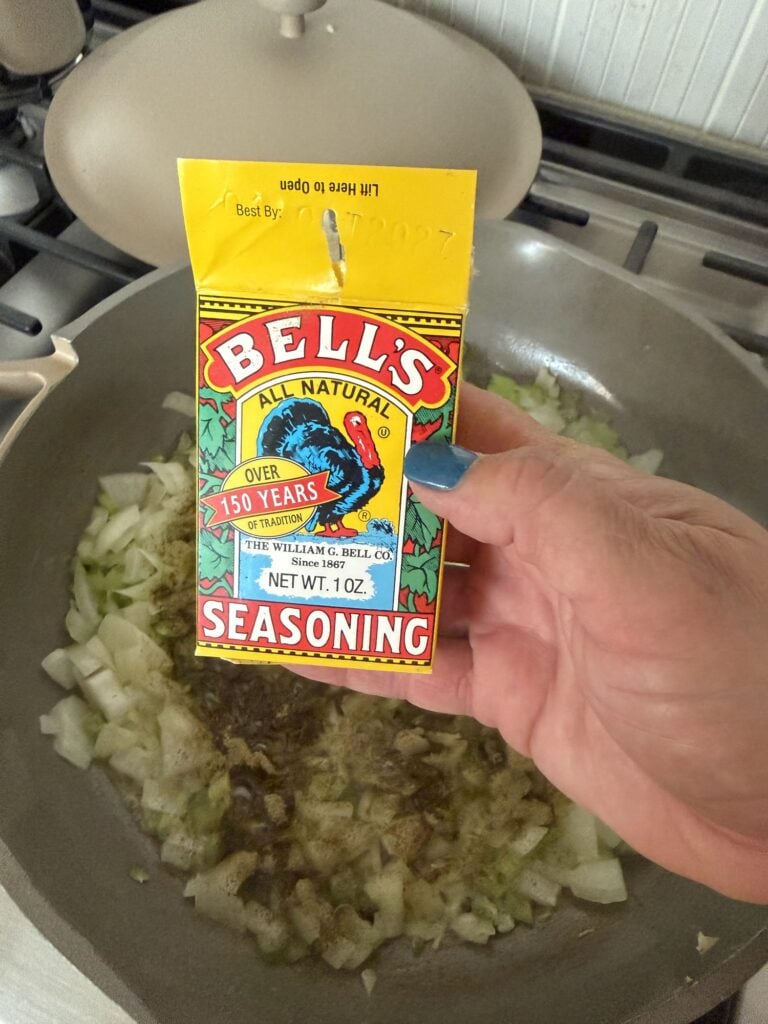
Someone told me about Bell’s Seasoning, and once I started looking into it, I realized this little box has quite a history. Bell’s dates all the way back to 1867, when William G. Bell created his seasoning blend in Boston. The company calls it America’s oldest seasoning and spice brand, and it became especially associated with Thanksgiving cooking throughout New England. The formula has remained unchanged for generations.
Bell’s Seasoning contains rosemary, oregano, sage, ginger, marjoram, thyme, and pepper. One of the things I especially like about it is that there is no salt in the seasoning, which means you have much more control over the saltiness of your finished stuffing.
If you smell it straight from the box, it smells like Thanksgiving. Sage and the other herbs give you that familiar poultry-seasoning aroma, but the ginger and pepper add a little something different in the background.
Where To Buy Bell’s Seasoning
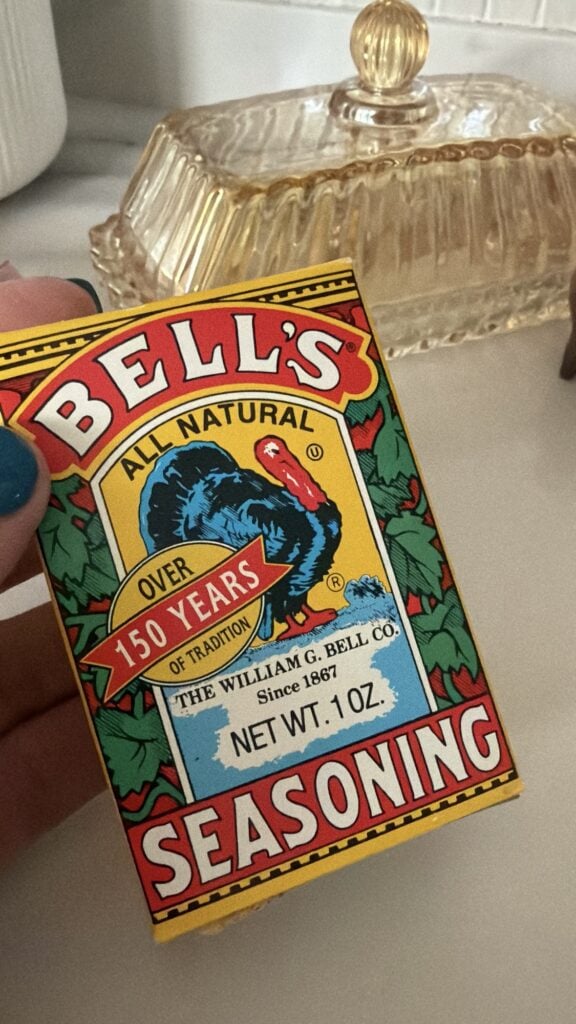
Bell’s Seasoning can sometimes be a little harder to find depending on where you live. The company lists select grocery stores around the country that carry it, and some stores only stock Bell’s products seasonally around the holidays. I will provide a link to purchase it below.
*The following is an Amazon Affiliate Link. As an Amazon Associate, I earn a commission from qualifying purchases at no extra cost to you.*
Here is the Bell’s Seasoning I use for purchase.
One important warning: be careful when opening the Bell’s box. The seasoning is packaged directly inside the cardboard box rather than inside a separate little plastic pouch. Don’t tear into the box like a wild animal and accidentally dump your Thanksgiving seasoning all over the counter. Open the pour spout carefully.
Start With Dried White Bread
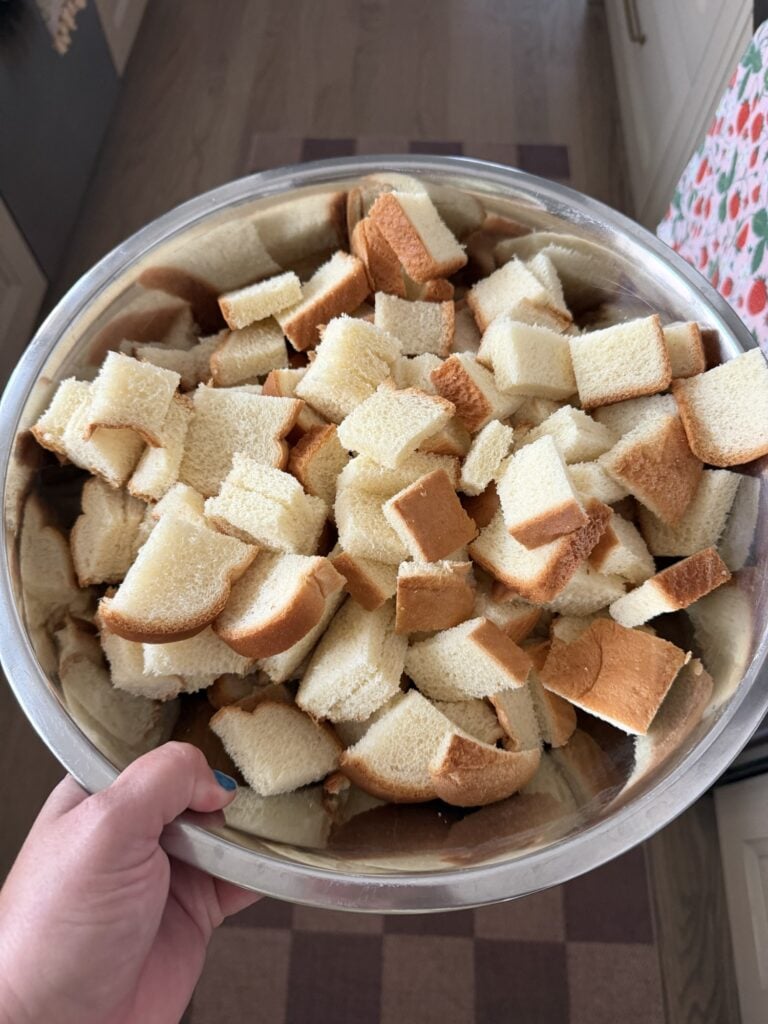
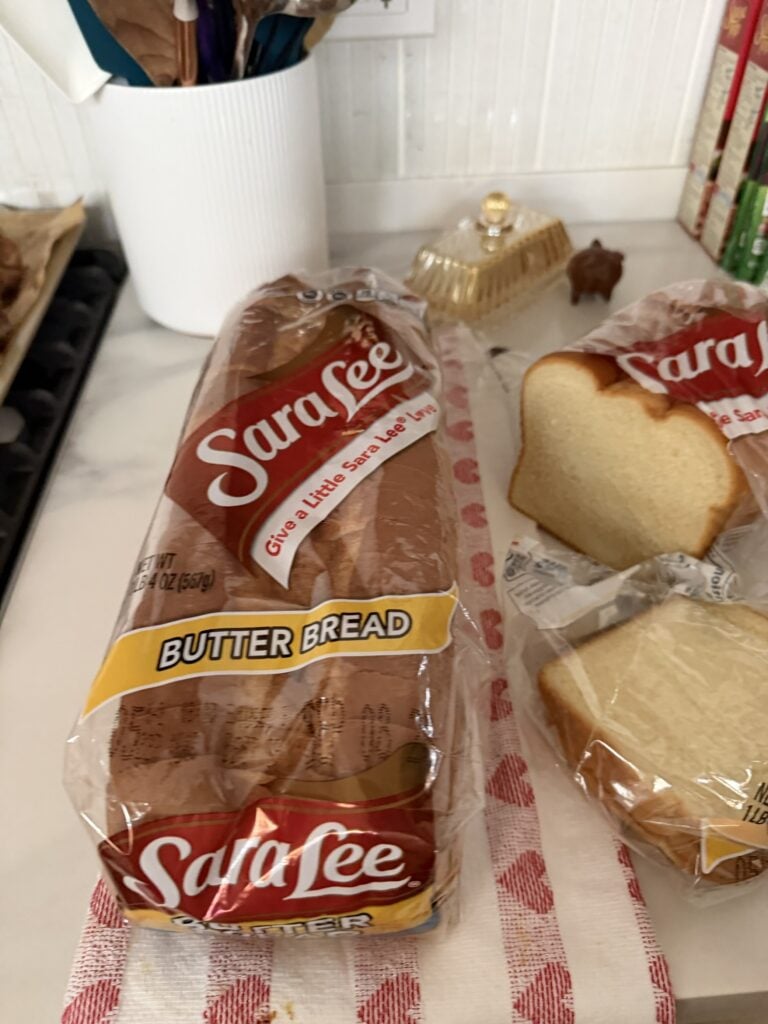
For this stuffing I used two larger loaves of Sara Lee white bread. Honey White or Butter Bread both work nicely here as well. Cut the bread into cubes, place it in a very large bowl, and leave it sitting out overnight.
I lightly cover the bowl with a clean kitchen towel. You want air to get to the bread so it can dry, but you don’t need every dust particle in your house becoming part of Thanksgiving dinner.
Drying the bread is important because we are going to add quite a bit of flavorful liquid. Fresh, super-soft bread can turn into paste before it has a chance to absorb everything properly.
How Much Bread Do You Need For Stuffing?
For this recipe, I use two larger loaves of soft white sandwich bread, such as Sara Lee Honey White or Butter Bread. Depending on the exact size of your loaves, this should give you roughly 20 to 24 cups of loosely measured bread cubes once the bread is cut up. Don’t get too hung up on an exact cup measurement, though. The size and density of sandwich bread varies from brand to brand, which is also why I give you a range for the broth later in the recipe.
Cut the bread into approximately 3/4-inch to 1-inch cubes. They don’t have to be perfectly uniform. In fact, I like having a few slightly smaller pieces mixed in because they absorb the buttery broth particularly well, while the larger pieces help give the finished stuffing some structure. I wouldn’t cut the bread much larger than an inch for this particular stuffing because we’re going for that soft, fluffy, almost custardy texture rather than a stuffing made from big, distinct chunks of bread.
You can also get this job out of the way well before Thanksgiving. Cut the bread into cubes, spread it out on sheet pans, or place it in large bowls and allow it to air-dry until the cubes are thoroughly dry. Once completely dry, transfer them to freezer bags or airtight freezer containers and freeze them. When you’re ready to make the stuffing, take the bread out of the freezer and let it come back to room temperature before adding your hot broth mixture. This is a really easy thing to prep days or even weeks ahead, and it’s one less cutting board covered in bread crumbs when you’re trying to cook Thanksgiving dinner.
Finely Chop The Celery And Onions
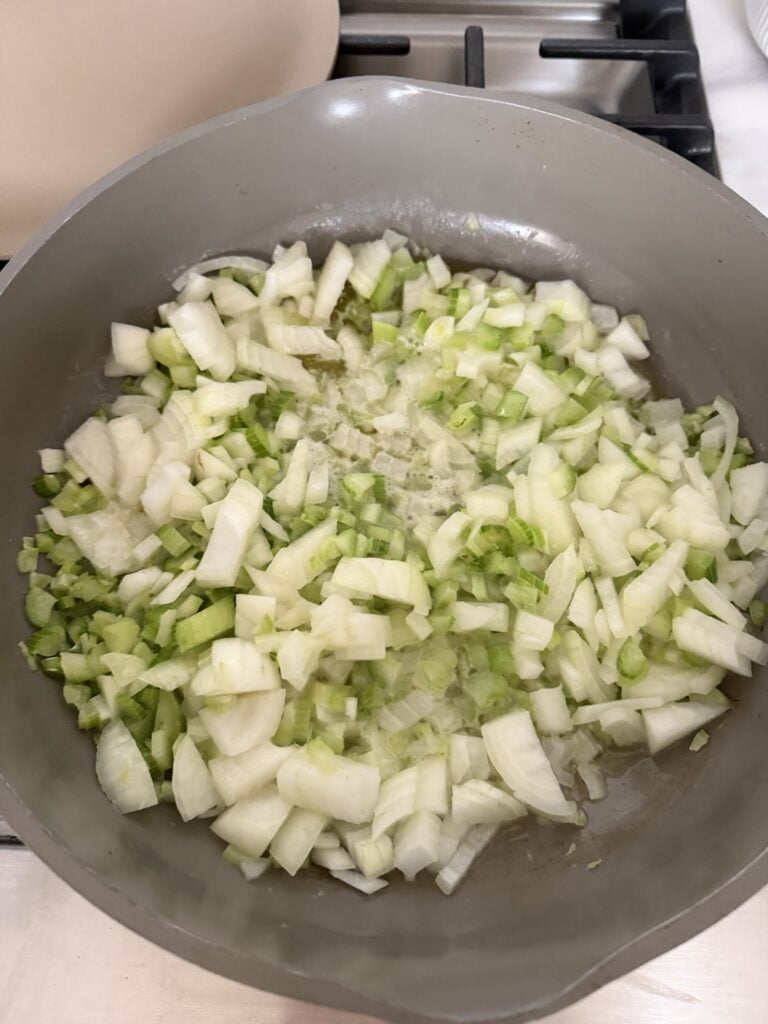
I use about six ribs of celery and three sweet onions, usually Vidalia onions.
I want these very finely chopped. You can do this by hand, but this is also a great job for your food processor. Pulse the vegetables until they’re finely minced but do not purée them. We aren’t making onion and celery juice.
The fine dice is important to this particular stuffing because I don’t want big chunks of vegetables interrupting that soft, almost custard-like interior.
Yes, We Are Using That Much Butter
This is Thanksgiving stuffing. I make no apologies.
Melt one full stick of butter in a large skillet and add your finely chopped onions and celery. Cook them slowly until they are extremely soft and tender.
Later we’re going to put another four tablespoons of butter over the top before baking.
The butter in the skillet adds richness throughout the bread, while the butter on top helps create those browned, crispy pieces that everyone tries to steal from the casserole dish.
The Little Splash Of Soy Sauce
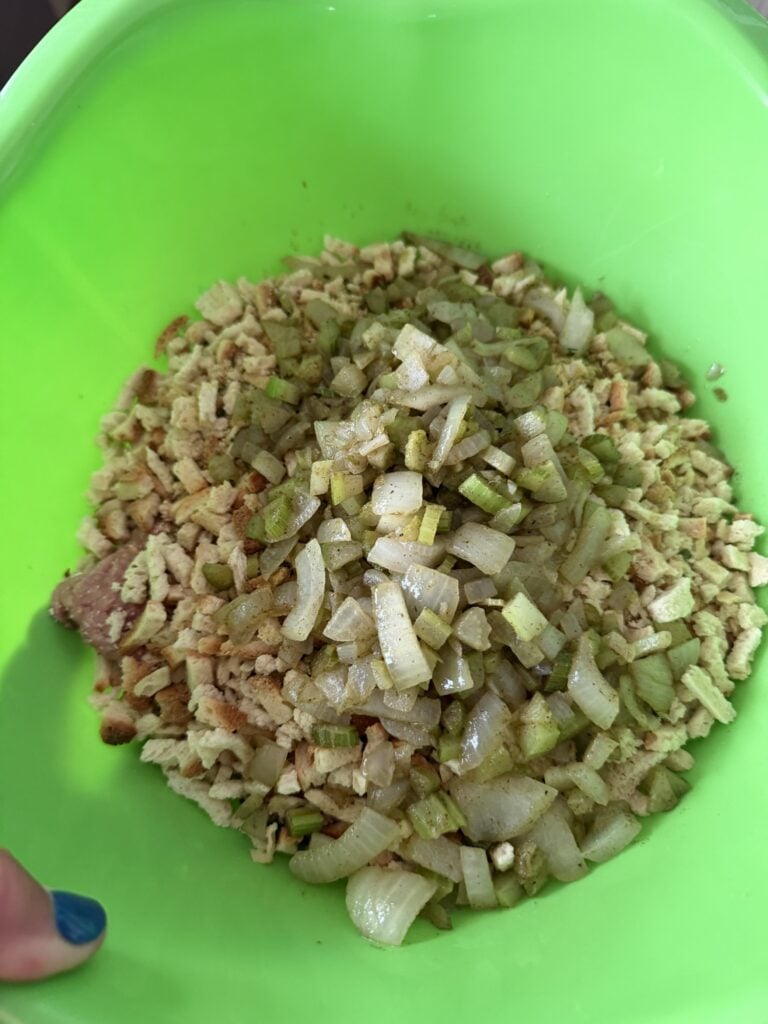
Once my vegetables are soft, I add Bell’s Seasoning, celery salt, and a small splash of soy sauce.
The soy sauce isn’t there to make the stuffing taste like soy sauce. It adds a little savory umami and gives some depth to all that butter, bread, and sweet onion. It also helps balance the slight sweetness of the bread.
You only need a splash. This is a background ingredient, not a dominant flavor.
Remember that soy sauce, celery salt and your prepared broth can all contain sodium, while Bell’s itself is salt-free. Taste and adjust rather than automatically adding more salt.
Make The Buttery Broth Mixture
After seasoning the vegetables, add about 3 cups of chicken broth.
I like making mine with Better Than Bouillon. During the holidays, when I can find their turkey flavor, I use turkey broth instead. Either is delicious.
Let the broth, vegetables, butter, and seasonings simmer together for about 10 minutes.
Pour this entire mixture over your dried bread and gently stir everything together.
Then wait.
Give the bread about 10 minutes to absorb the liquid, stirring occasionally. This is where you need to pay attention rather than blindly following a measurement.
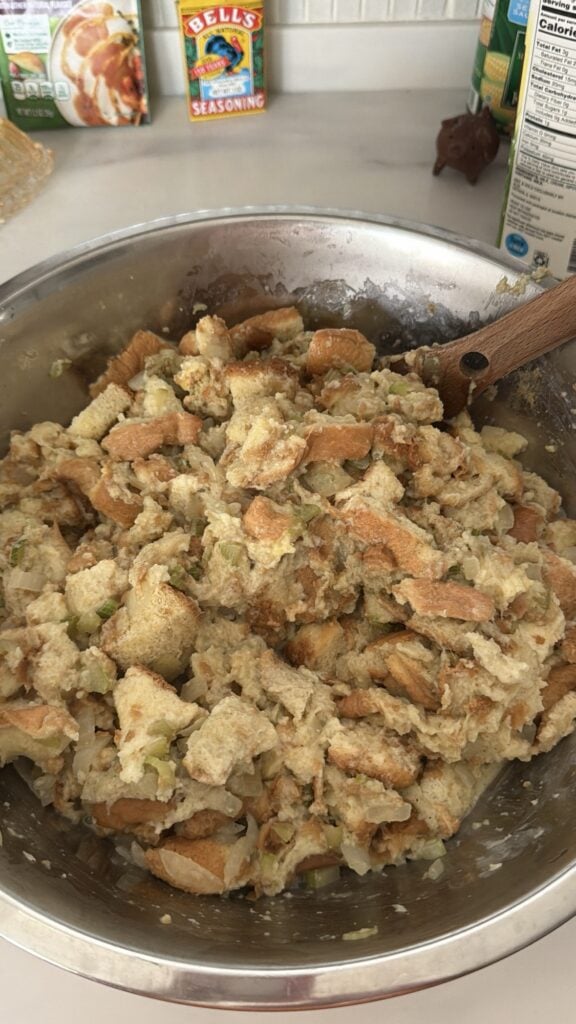
How Wet Should Stuffing Be Before Baking?
THIS IS THE SECTION I WANT YOU TO READ IF YOU ARE MAKING THIS FOR THE FIRST TIME.
Different breads absorb different amounts of liquid.
The measurements in my recipe are what worked with the bread I used, but your loaf may be larger, smaller, fresher, drier, or simply more absorbent.
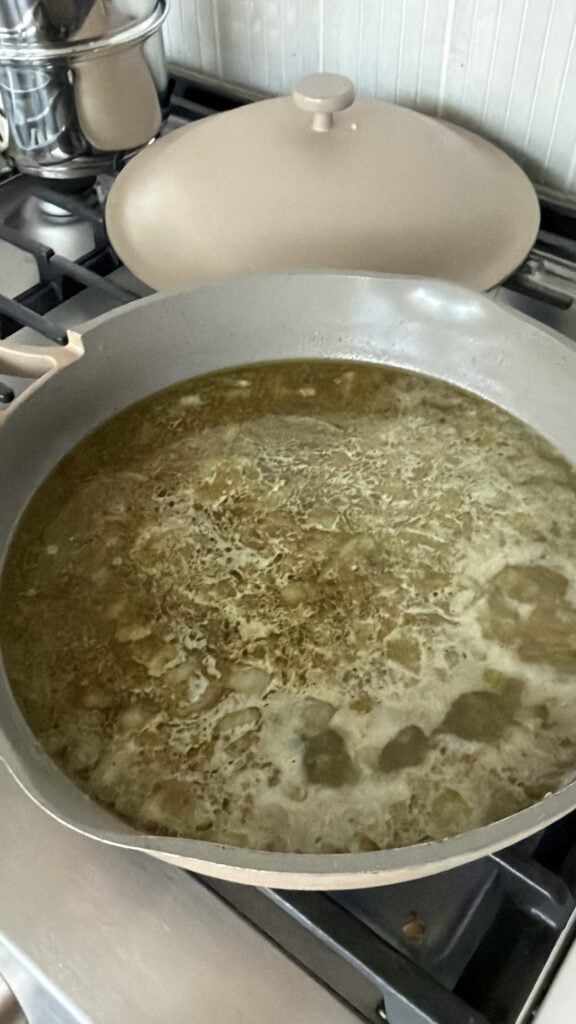
The bread should be very moist and quite soggy, but it should not be floating in liquid.
After adding the original 3 cups of broth, let it sit for about 10 minutes before deciding whether it needs more. If you still have obviously dry bread throughout the mixture, gradually add additional broth. You may need up to approximately 1 additional cup.
On the other hand, if you are using a different bread that absorbs less liquid, do not force all the broth into it just because the recipe gives you a measurement.
The picture below shows you exactly what mine looked like before baking. Use the photo as your guide.
Why I Add Eggs And Heavy Cream
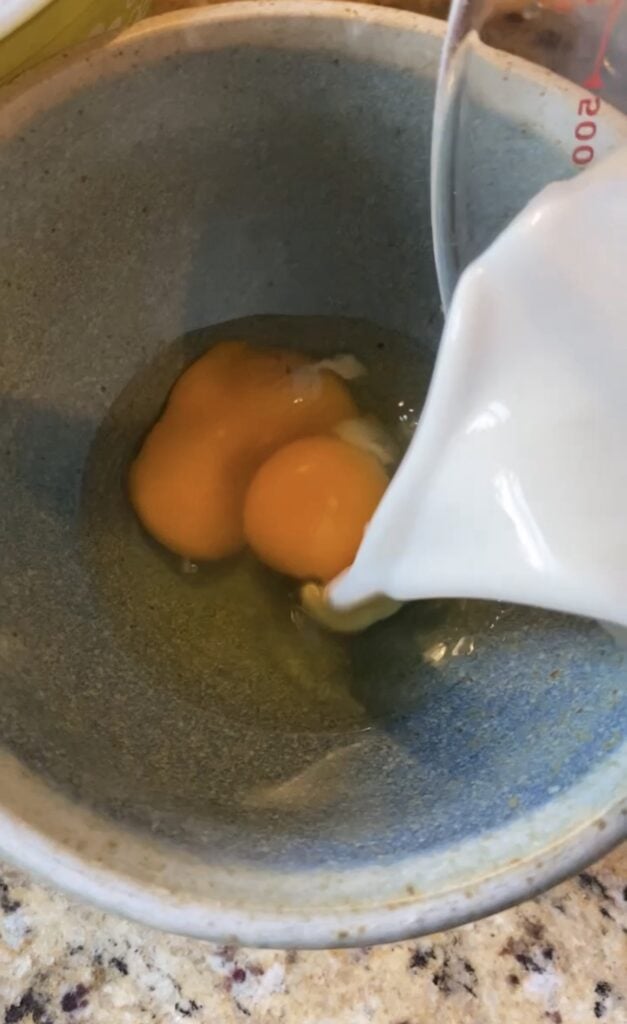
In a separate bowl, whisk together 2 eggs and 1 cup of heavy cream.
This is what makes this stuffing different.
The eggs and cream create an almost savory bread-pudding or soufflé effect. As the stuffing bakes, the egg mixture sets around the bread and the casserole actually puffs up. The center stays incredibly soft and fluffy while the uncovered top becomes buttery and crisp.
Do not add the egg mixture while the bread and broth are piping hot.
After pouring the hot broth mixture over the bread, let everything sit and cool for about 10 minutes, stirring occasionally. Once it has cooled down sufficiently, gently mix in the egg and cream.
And remember: the cream is additional liquid. If your bread already seems very wet after adding the broth, keep that in mind before adding extra broth.
Into The Casserole Dish
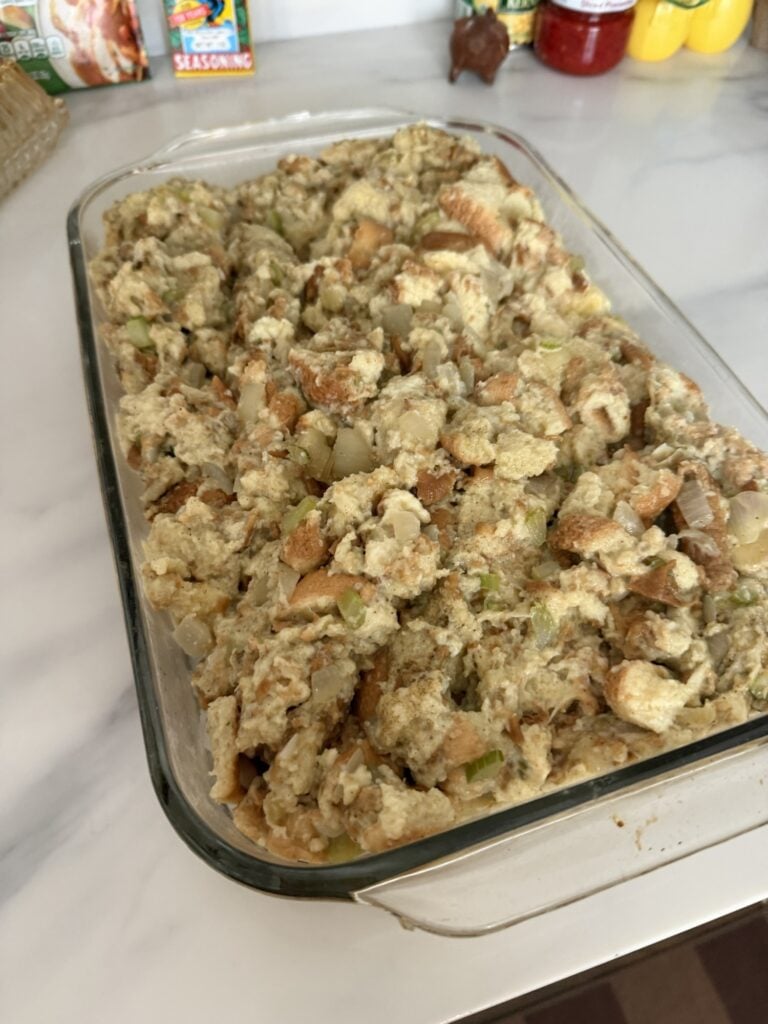
Butter a 9 x 13-inch glass casserole dish and transfer the stuffing mixture into it.
Don’t mash it down into the dish. Spread it evenly while allowing it to stay somewhat loose so that the stuffing can puff as it bakes.
Season the top with a light sprinkle of celery salt, black pepper and a few additional pinches of Bell’s Seasoning.
Then cut 4 tablespoons of butter into thin pieces and distribute them all over the surface.
I also sprinkle dried parsley over the top. Does dried parsley contribute some enormous explosion of flavor? No. Does it make everything look prettier? Yes. Sometimes that’s enough for me.
Baking The Stuffing
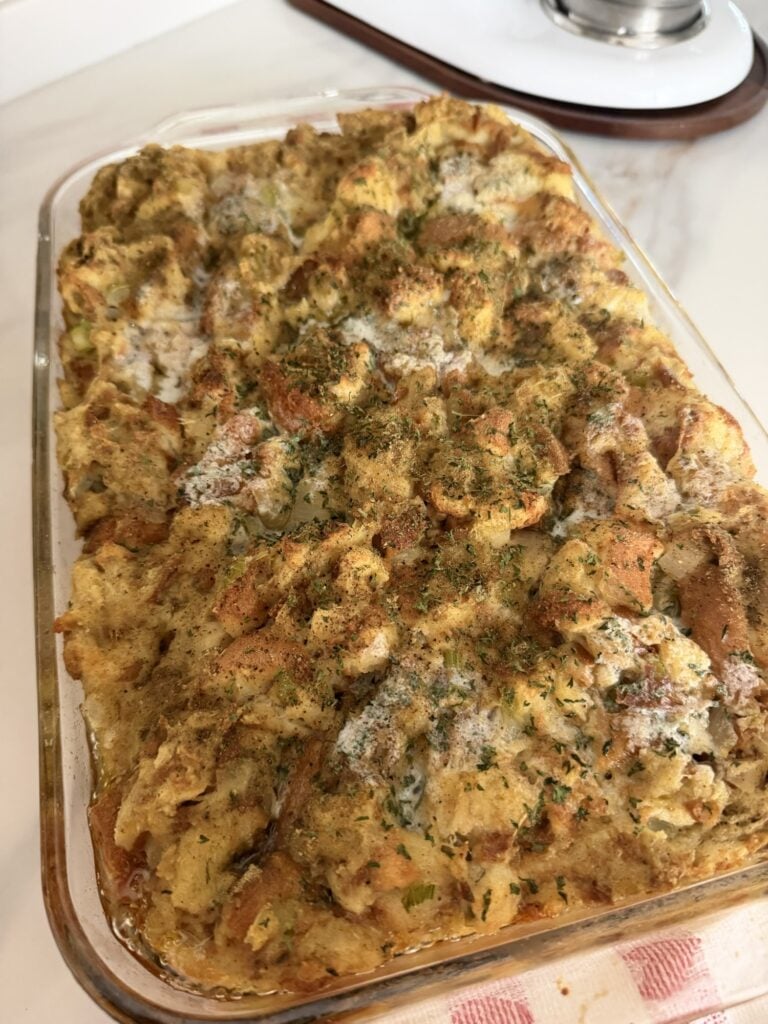
Bake the stuffing uncovered at 375°F for approximately 45 minutes.
Every oven is different, so the first time you make this, start watching it toward the end of the baking time.
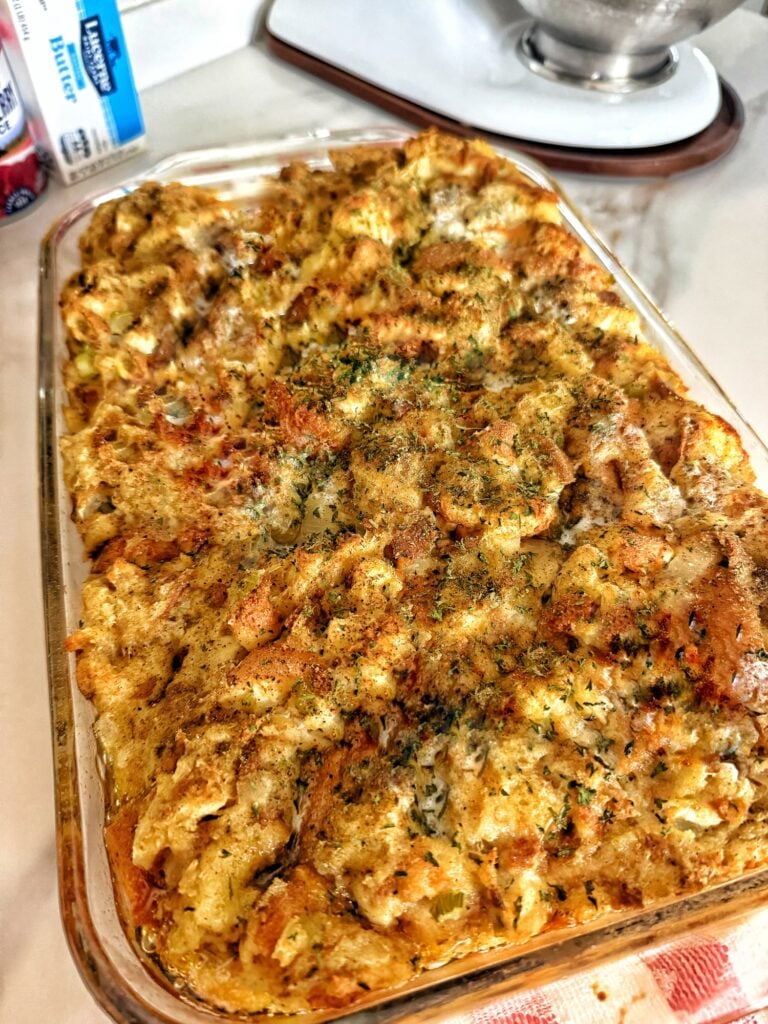
You are looking for a beautiful transformation. The stuffing should puff and rise almost like a soufflé. The top and edges will develop golden, crispy areas while the center stays moist, soft, and fluffy.
Because this recipe contains eggs, the center should be fully cooked. For an extra check, the center of the casserole should reach 165°F on an instant-read thermometer.
Let it rest for about 10 minutes before serving. It will settle slightly as it rests, which is completely normal.
Can You Make This Stuffing Ahead?
Yes, and this is a great stuffing to make ahead for a holiday when your oven is already doing overtime. For an unbaked make-ahead version, assemble the stuffing completely in the buttered casserole dish, including the butter and seasonings on top, cover it tightly and refrigerate it for up to 24 hours. When you are ready to bake, let the dish sit on the counter for about 20 to 30 minutes while the oven heats, then bake as directed. Because the stuffing is starting cold, it may need an additional 10 to 20 minutes in the oven. Keep an eye on the top and make sure the center reaches 165°F. If the top is browning before the center is hot, loosely cover it with foil.
You can also bake the stuffing completely the day before. Let it cool, cover, and refrigerate. To reheat the whole casserole, cover it with foil and heat at 325°F to 350°F until hot in the center, usually about 25 to 35 minutes depending on how cold and deep the casserole is. If it seems a little dry, drizzle a small amount of chicken or turkey broth around the edges before covering it. Remove the foil for the final 5 to 10 minutes if you want to crisp the top again.
If your Thanksgiving oven is packed, you have a few other options. Individual servings reheat beautifully in the microwave; cover them loosely and heat in short intervals until steaming hot. For a larger amount, you can reheat portions in a covered skillet over low heat with a small splash of broth, stirring gently so you don’t completely break up the stuffing. A slow cooker is also useful for keeping already-reheated stuffing hot during dinner.
Reheat the stuffing first until it reaches 165°F, then transfer it to a preheated slow cooker set to LOW or WARM. Add a couple tablespoons of broth if needed and keep the lid on so the stuffing stays moist. I would not use the slow cooker to bring refrigerator-cold stuffing all the way back up to temperature; it is much better as a holding option once the stuffing is already piping hot.
Want To Add Sausage?
You absolutely can.
Add 1 pound of breakfast sausage to the skillet and cook it thoroughly, breaking it into small crumbles. I especially like a breakfast sausage made with sage for stuffing.
Once the sausage is cooked, add the butter, celery, and onions and proceed with the recipe.
Sage sausage combined with Bell’s Seasoning makes this an especially savory version and would be wonderful for Thanksgiving or Christmas.
If your sausage renders a lot of fat, you can drain off some of the excess before adding the butter and vegetables. I would still keep enough of those flavorful drippings to make the stuffing delicious.
What About Applesauce In Stuffing?
My best friend’s mom makes a stuffing using applesauce instead of heavy cream, and I love the idea, especially for a stuffing served with pork.
Applesauce adds moisture while bringing a gentle sweetness and apple flavor that naturally complements pork roast, pork chops, and sausage.
I haven’t tested a direct one-for-one applesauce substitution in this exact recipe, so I’m not going to tell you to dump a cup into the casserole and hope for the best. If I develop that version, I would adjust the other liquids around it.
But the idea of a Bell’s-seasoned apple stuffing with sage sausage alongside a pork roast? That deserves its own recipe.
What To Serve With Bell’s Seasoning Stuffing
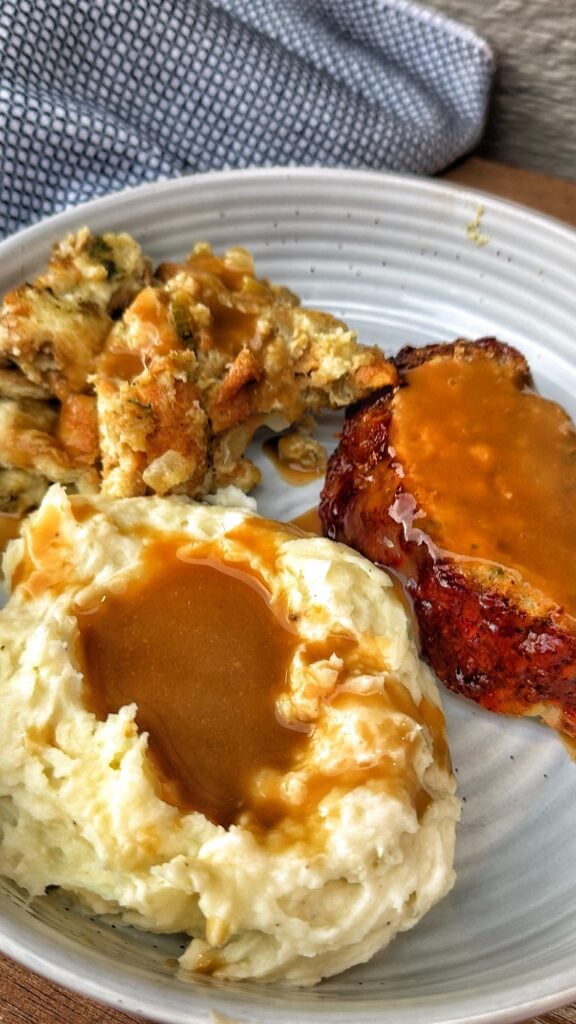
Obviously this is made for Thanksgiving. Serve it alongside turkey, mashed potatoes, gravy, cranberry sauce, sweet potatoes and all the other classics.
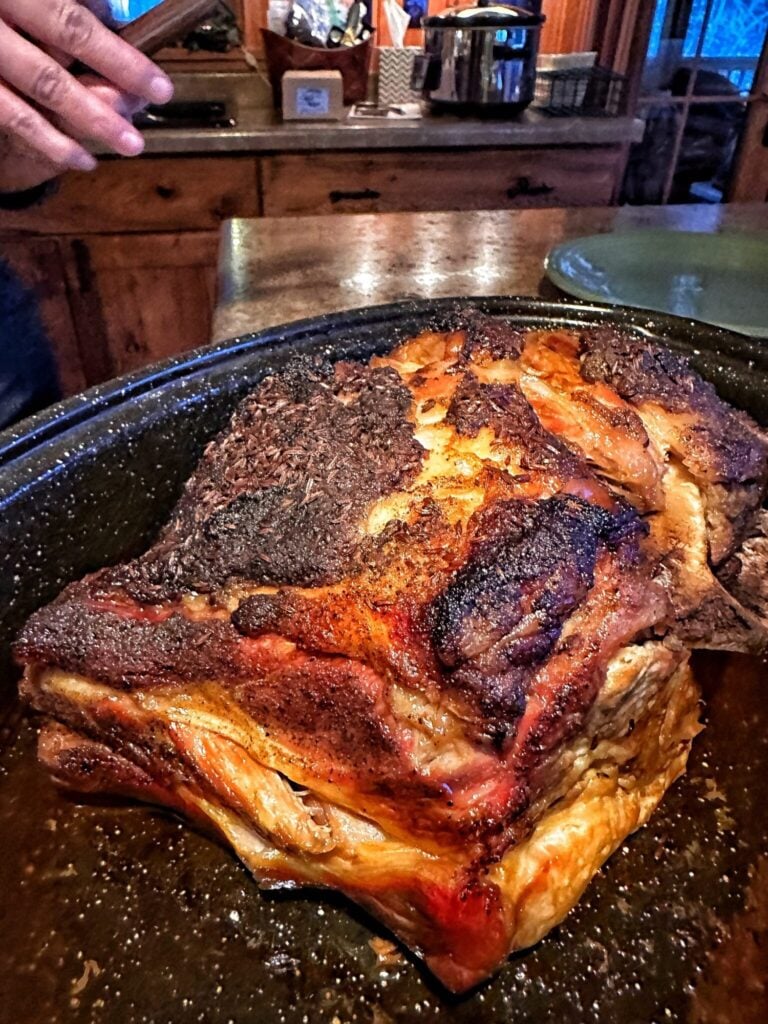
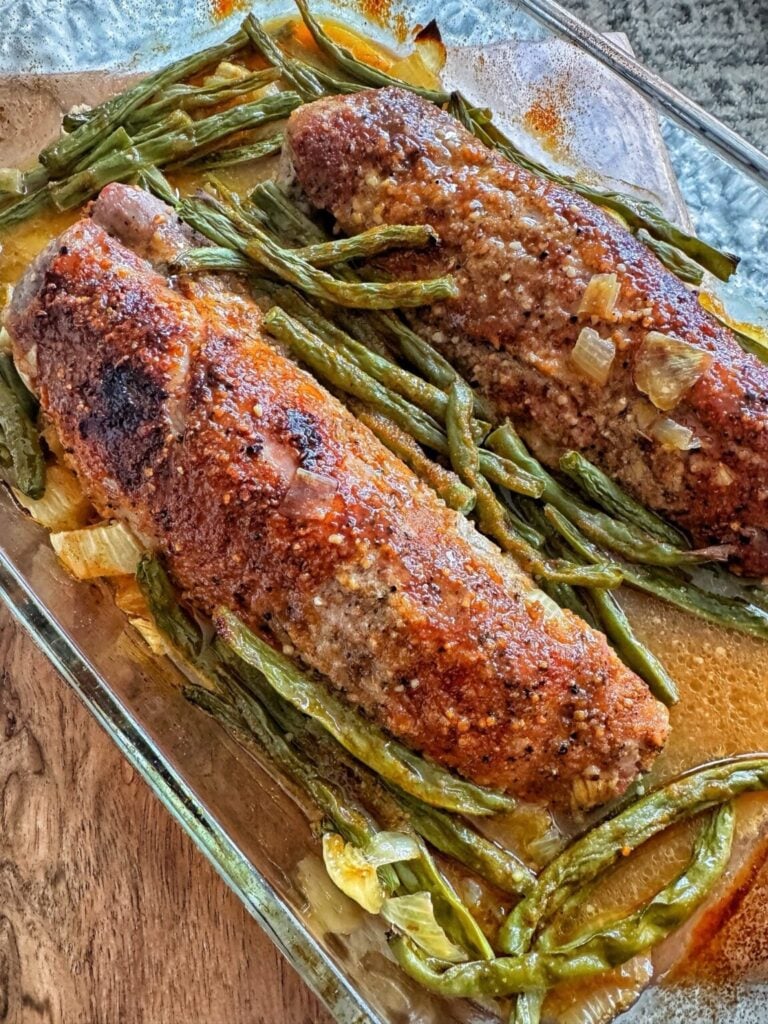
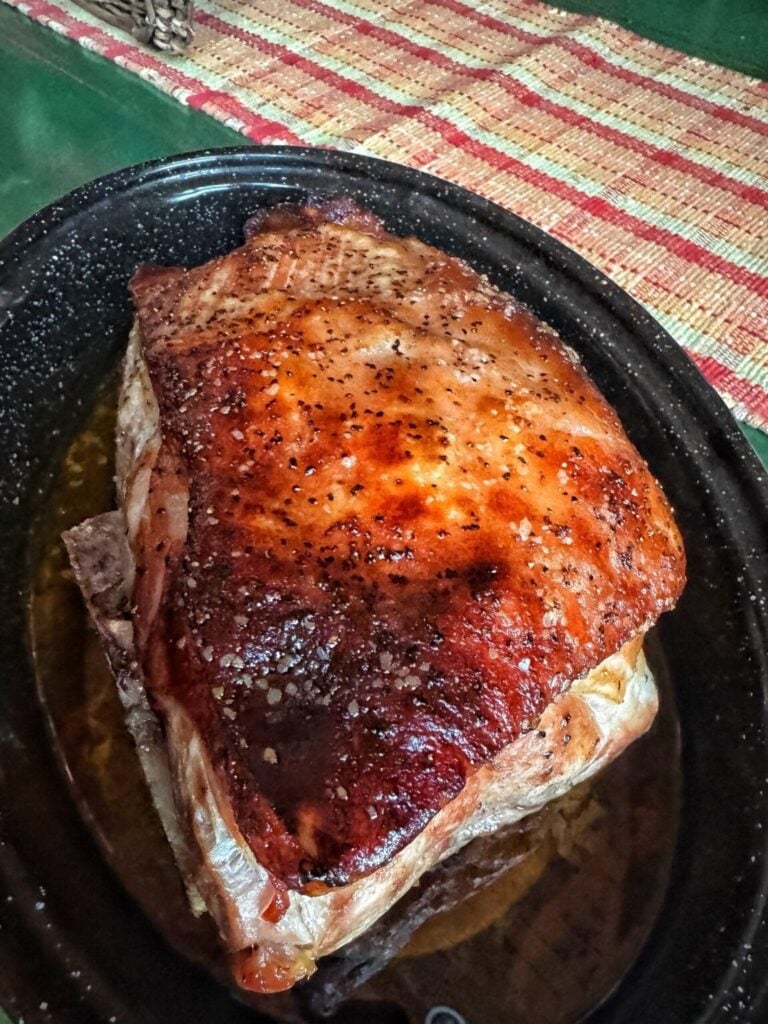
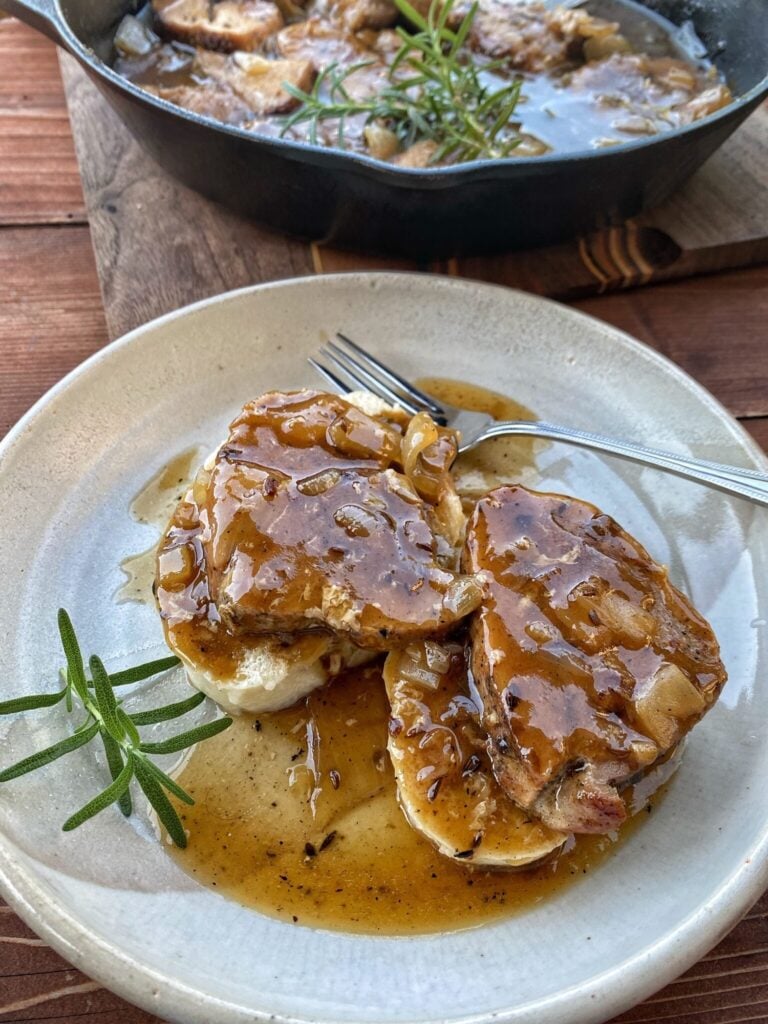
But don’t save it exclusively for Thanksgiving. This would be excellent with roasted chicken, pork roast, baked ham or pork chops. I really think any of my pork recipes would be fantastic with this! You can click each image to get the recipe.

Frequently Asked Questions About Bell’s Seasoning Stuffing
What is Bell’s Seasoning?
Bell’s Seasoning is a classic American poultry seasoning blend made with rosemary, oregano, sage, ginger, marjoram, thyme, and pepper. It does not contain salt, which is helpful in this recipe because the broth, celery salt, and soy sauce all contribute saltiness. It has that familiar savory, herby aroma, that most of us associate with Thanksgiving stuffing.
Can I use regular poultry seasoning instead of Bell’s Seasoning?
Yes. If you cannot find Bell’s Seasoning, you can substitute another poultry seasoning, but the flavor won’t be exactly the same because every blend is a little different. Also check whether your poultry seasoning contains salt before adding the full amount of celery salt called for in the recipe.
How much bread do I need for this stuffing?
I use two larger loaves of soft white sandwich bread, such as Sara Lee Honey White or Butter Bread. This is approximately 20 to 24 cups of loosely measured bread cubes, depending on the size and density of the loaves. Cut the bread into approximately 3/4-inch to 1-inch cubes.
Do I really need to dry the bread overnight?
I highly recommend it. Dry bread absorbs all that buttery, seasoned broth without immediately turning into paste. Cut the bread the day before and leave it loosely covered with a clean kitchen towel overnight. You can also dry the bread well in advance and freeze the completely dried cubes until you’re ready to make the stuffing.
How wet should stuffing be before it goes into the oven?
This stuffing should look quite wet and soggy before baking, but there should not be liquid pooling around the bread. Different breads absorb liquid differently, which is why the broth measurement is somewhat flexible. Scroll up to my process photo showing exactly how my stuffing looked before baking. That visual is more useful than blindly adding a specific amount of broth.
Why does this stuffing have heavy cream and eggs?
The eggs and heavy cream give this stuffing its special texture. Instead of being dry or crumbly, the inside becomes soft, fluffy, and almost custard-like. The eggs also help the casserole puff as it bakes, almost like a savory bread pudding or soufflé, while the uncovered top develops crispy buttery pieces.
Why is there soy sauce in Thanksgiving stuffing?
It’s just a small splash, and your stuffing will not taste like soy sauce. I use it to add a little extra savory depth and umami to the butter, onions, celery, and broth. It also helps balance the slight sweetness of the white bread and Vidalia onions.
Can I use turkey broth instead of chicken broth?
Absolutely. In fact, turkey broth is my first choice for Thanksgiving. I like using Better Than Bouillon, and when their turkey flavor is available around the holidays, I use that. Chicken broth works beautifully any time of year.
Can I make this stuffing ahead of time?
Yes. You can assemble the stuffing, cover it, and refrigerate it unbaked for up to 24 hours before baking. You can also bake the entire casserole the day before and reheat it for your holiday meal. See my Make-Ahead Stuffing section above for complete instructions, including options for reheating when your Thanksgiving oven is already full.
Can I keep stuffing warm in a slow cooker?
Yes, but I prefer using the slow cooker to keep already-hot stuffing warm rather than reheating refrigerator-cold stuffing from scratch. Reheat the stuffing until the center reaches 165°F, then transfer it to a preheated slow cooker on LOW or WARM. If necessary, add a small splash of broth to help keep it moist.
Can I add sausage?
Yes, and it’s delicious. Brown 1 pound of breakfast sausage before cooking the celery and onions. I especially like sage breakfast sausage because it complements the herbs in Bell’s Seasoning. Drain excessive grease if necessary, but leave a little behind for flavor.
Can I use a different kind of bread?
You can, but you’ll need to pay extra attention to the liquid. A sturdy bakery loaf, French bread, brioche, or another sandwich bread may absorb a very different amount of broth than the soft white bread I use. Start with less liquid and add more gradually. The process photo in the post will show you the consistency you’re trying to achieve.
Can I make this stuffing without heavy cream?
You can experiment with another dairy option, but changing the heavy cream will change the richness and possibly the texture of the finished stuffing. I would use whole milk or half-and-half before using a low-fat milk. Because I developed this particular version with heavy cream, that is what I recommend for the soft, rich, custardy result shown in my photos.
Is this stuffing sweet or savory?
It’s definitely savory, but it has a slight sweetness from the soft white bread and sweet onions. The Bell’s Seasoning, celery, broth, soy sauce, and celery salt balance that sweetness. If you add sage breakfast sausage, the finished stuffing becomes even more savory.
How do I know when the stuffing is done?
The top should be golden with crispy areas around the surface and edges, and the stuffing should puff noticeably as it bakes. The inside will remain soft and moist rather than becoming dry. Since the recipe contains eggs, I recommend checking the center with an instant-read thermometer; it should reach 165°F.
Why did my stuffing need more or less broth than the recipe?
That’s completely normal. Bread varies in moisture, density, loaf size, and how thoroughly it was dried. Even two different brands of white sandwich bread can absorb different amounts. That’s why this recipe gives you a starting amount of broth rather than telling you that every last drop must go into the bowl. Let the bread tell you when it has enough liquid.
Bell's Seasoning Stuffing Recipe
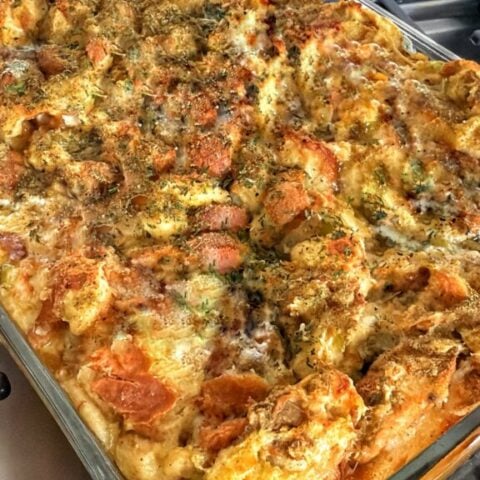
A rich and buttery Bell’s Seasoning stuffing made with dried white bread, finely diced celery and sweet onions, chicken or turkey broth, eggs, and heavy cream. It bakes up almost like a savory soufflé with a soft, fluffy, custardy center and buttery crispy edges.
Ingredients
- 2 large loaves soft white sandwich bread, such as Sara Lee Honey White or Butter Bread, cut into 3/4-inch to 1-inch cubes (approximately 20 to 24 cups loosely packed)
- 6 celery ribs, very finely diced
- 3 sweet onions, preferably Vidalia, very finely diced
- 8 tablespoons (1 stick) butter
- 1/2 tablespoon Bell’s Seasoning*, plus additional for the top, or to taste
- 2 teaspoons celery salt, approximately, plus additional for the top, to taste
- Small splash soy sauce, approximately 1 to 2 teaspoons
- 3 cups prepared chicken or turkey broth, plus up to approximately 1 additional cup if needed
- 2 large eggs
- 1 cup heavy cream
- Black pepper, to taste
- 4 tablespoons butter, thinly sliced
- Dried parsley, for topping
Optional:
- 1 pound sage or traditional breakfast sausage, cooked and crumbled
- *I link the Bell’s Seasoning I use in the post above, including an Amazon purchase option.
Instructions
- The day before baking, cut the bread into cubes and place it in a very large bowl. Leave the bread out overnight to dry, loosely covered with a clean kitchen towel.
- When ready to prepare the stuffing, heat the oven to 375°F.
- Finely dice the celery and onions. A food processor can be used, but pulse carefully. The vegetables should be very finely minced, not liquefied.
- Melt 8 tablespoons butter in a large skillet over medium to medium-low heat. Add the celery and onions and sauté until extremely soft and tender.
- Add approximately 1/2 tablespoon Bell’s Seasoning, about 2 teaspoons celery salt and a small splash of soy sauce. Seasoning amounts can be adjusted to taste.
- Add 3 cups chicken or turkey broth. Bring to a gentle simmer and cook for approximately 10 minutes.
- Pour the entire hot broth and vegetable mixture over the dried bread. Gently toss until evenly distributed.
- Allow the bread mixture to sit for approximately 10 minutes, stirring occasionally, so you can see how much liquid the bread absorbs. Allow the mixture to cool during this time.
- Meanwhile, whisk 2 eggs and 1 cup heavy cream together in a separate bowl.
- Examine the bread before adding additional broth. It should be very moist and quite soggy but should not be floating in liquid. Different breads absorb different amounts. Add additional broth gradually only if needed.
IMPORTANT: Scroll up in this post and look at my photo under “How Wet Should Stuffing Be Before Baking?” That picture shows exactly how moist my stuffing was before baking. Use the appearance of the mixture as your guide rather than relying solely on a measurement.
- Once the bread mixture has cooled enough that it is no longer piping hot, gently fold in the egg and heavy cream mixture.
- Butter a 9 x 13-inch glass casserole dish and transfer the stuffing to the dish. Spread evenly without tightly packing or compressing it.
- Sprinkle the top lightly with additional celery salt, black pepper and a few pinches of Bell’s Seasoning.
- Cut the remaining 4 tablespoons butter into thin pieces and distribute them evenly over the stuffing. Sprinkle with dried parsley.
- Bake uncovered at 375°F for approximately 45 minutes, or until the stuffing has puffed, the top and edges are golden and crisp, and the center is cooked through. The center should reach 165°F.
- Allow the stuffing to rest approximately 10 minutes before serving.
Notes
- THE LIQUID IS ADJUSTABLE: Bread varies enormously. The 3 cups of broth worked with the bread used for this recipe, but another bread may need more or less. Do not automatically add the additional cup.
- LOOK AT THE PHOTO: There is a photograph in the post showing exactly how wet the stuffing should look before baking. Scroll up and use this as a visual reference.
- The texture: This is intentionally a very moist stuffing. Eggs and heavy cream create a soft, fluffy, almost custard-like interior while the uncovered baking method creates crispy edges and a buttery top.
- Bell’s Seasoning: Bell’s itself is salt-free. However, celery salt, soy sauce, prepared broth and sausage can all contribute sodium, so taste and season accordingly.
- For turkey flavor: During the holiday season, I like using turkey-flavored Better Than Bouillon when I can find it. Chicken broth works perfectly the rest of the year.
- For sausage stuffing: Brown 1 pound breakfast sausage, preferably sage sausage, and crumble it finely. Add it to the stuffing mixture. If the sausage produces a large amount of grease, drain some before proceeding.
- Make-ahead option: Assemble the stuffing, cover tightly and refrigerate. For best results, bake within 24 hours. Because the casserole will be cold, it may require additional baking time. Make sure the center reaches 165°F.
- Bread Prep: The bread can be cubed and dried well ahead of time. Once completely dry, store it in airtight freezer bags and freeze until needed. Bring the cubes back to room temperature before making the stuffing.