
Chicago Style Stuffing

Holiday Stuffing Or Italian Beef Sandwich? Both!
Chicago Style Stuffing takes everything I love about a good Chicago Italian beef sandwich and turns it into one big pan of Thanksgiving stuffing.
This stuffing is made with chewy French bread, mild Italian sausage, onions, celery, mild giardiniera and lots of savory herbs and seasonings.

But the thing that REALLY makes it taste like Chicago is the beefy au jus.
The bread soaks up all that buttery, sausage-filled, beefy liquid before everything gets baked until the middle is soft and savory and the top has those crispy golden edges everyone fights over.
If your family loves Italian beef, this is the Thanksgiving stuffing I want you to make.
It’s also PERFECT for Friendsgiving when you want to bring something a little different to the table.
Before You Jump to the Recipe
Here are the most important things to know before you start:
- This is a BIG pan of stuffing. It is meant to feed a holiday crowd.
- Use a chewy French bread. You need bread that can absorb all that flavorful liquid without completely disappearing.
- You do not have to dry the bread for days. This recipe was developed using regular French bread.
- Buy a little extra bread if you’re nervous. If your particular bread absorbs less liquid, you can add a few more cubes.
- Cut the bread into small bite-size pieces. Smaller pieces absorb the sausage and au jus mixture more evenly.
- I use mild Italian sausage instead of Italian beef. It stays juicy and distributes that Italian-beef-style flavor throughout the stuffing.
- Cook the sausage completely before it goes into the stuffing.
- Mild giardiniera gives this its Chicago personality. You can use hot if that’s your thing.
- Use finely chopped giardiniera relish if possible. Large oily chunks aren’t what I want here.
- Tomato powder is optional but recommended. It adds another savory background flavor without turning this into tomato stuffing.
- Be careful with the salt. Au jus mix, beef bouillon, celery salt, sausage and giardiniera can all contribute sodium.
- Start with LESS bouillon and taste. You can always add more.
- The bread should be VERY moist before baking. Think saturated, not swimming.
- Let the hot bread mixture cool slightly before adding the eggs.
- This is baked separately in a casserole dish. I do not put this inside the turkey.
- The center should reach 165°F.
- Let it rest before serving. Five to ten minutes gives everything time to settle.
How Chicago Style Stuffing Happened
This recipe started exactly the way a lot of my recipes start.
I was eating something and thinking about something ELSE I could turn it into.
We had ordered Italian beef sandwiches from a neighborhood beef place here in Chicago.
I was eating that gloriously soggy bread that had soaked up all the beef juices and I thought:
“Wow. This would make GREAT stuffing.” That was it, I had to make it.
I started thinking about how I could get all those Italian beef flavors into a Thanksgiving stuffing without simply chopping up a bunch of Italian beef and drying it out in the oven.
The answer was Italian sausage, giardiniera, beefy au just and all of that with some chewy French bread.
Thanksgiving took a trip to the beef stand.
What Makes This “Chicago Style” Stuffing?
Let me clarify this before someone starts Googling the official Chicago Stuffing Commission.
I’m not claiming every Chicago family grew up eating this on Thanksgiving.
This is MY Chicago-inspired stuffing. Something different to keep stuffing for more than just one holiday.
It takes the flavors associated with one of our most famous foods, the Chicago Italian beef sandwich, and turns them into a holiday side dish.
The Chicago inspiration comes from:
Italian sausage
Giardiniera
Beefy au jus
Italian seasonings
French bread soaking up all those juices
That last part is especially important.
Anyone who has ordered an Italian beef dipped knows exactly what I’m talking about.
The bread absorbing the juice is half the experience. That’s what gave me the idea in the first place. I love that juicy piece of bread.
Why Italian Sausage Instead of Italian Beef?
This is probably the first question people have.
If it’s inspired by Italian beef, why isn’t there Italian beef IN the stuffing?
Because I didn’t want dried-out pieces of beef scattered throughout the bread. Easy answer.
Italian sausage has enough fat and moisture to stay juicy while the stuffing bakes.
When you crumble it finely, that sausage gets distributed throughout the entire pan.
Then we build the beef flavor into the LIQUID with the au jus or beef bouillon.
That means every bread cube gets that beefy flavor. I didn’t want the bits that had meat to be the only ones with flavor.

Mild Italian Sausage Works Best
I use one pound of mild Italian sausage.
If you’re buying links, remove the casings.
Bulk Italian sausage is even easier. I see this at lots of stores.
You want to break the sausage into a fairly fine crumble while it cooks.
I don’t want giant meatball-sized chunks throughout my stuffing. Unless you prefer that, you can make it your own.
The sausage should become part of the stuffing rather than taking over every bite. if that makes sense?
Can I Use Hot Italian Sausage?
Absolutely.
If your family likes a little more heat, hot Italian sausage would be delicious.
You could also do half mild and half hot.
Just remember we’re also adding giardiniera. Which has some heat.
If you’re using hot sausage AND hot giardiniera, you’re making a noticeably spicier stuffing.
Let’s Talk About the Bread
The bread is extremely important here because it has a big job.
It needs to absorb:
Butter
Sausage juices
Vegetable juices
Beefy au jus
Egg
Milk
And all those seasonings.
I use three mini French bread loaves weighing approximately seven ounces each.
That’s about 21 ounces of bread total.
Visually, once cubed, you’re looking at roughly 14 cups or possibly a little more depending on how large you cut your cubes.
Don’t become obsessed with getting exactly 14 cups.
The weight is a better measurement if your loaves are completely different sizes from mine. I also keep some extra bread on the side in case the mixture is too wet.

What Kind of French Bread Should I Buy?
I want something with a little CHEW.
A basic bakery French loaf works.
Mini French loaves work.
A sturdy Italian loaf can work.
You don’t need some extremely expensive artisan sourdough loaf. Unless you want to splurge, but it won’t make much difference in the outcome.
But I would avoid a very soft sandwich bread because we’re adding a significant amount of liquid. I would also avoid a sharp crusted bread. That bread tends to disintegrate when it gets wet.
The bread needs enough structure to absorb everything without turning into paste.
Does the Bread Have to Be Stale?
No.
This recipe was developed with regular French bread.
I am not asking you to leave bread sitting uncovered on your counter for three days.
The chewy structure of the French bread is part of why this recipe works.
If your bread is extremely fresh and unusually soft, you can cube it and let it sit out for a little while while you prepare the other ingredients. Just for a little bit.
But I wouldn’t intentionally dry it into croutons.
I WANT it to absorb those juices. Drying it out too much will make it fall apart in the liquid.
Buy a Little Extra Bread
This is one of my favorite stuffing insurance policies.
Bread varies.
One bakery’s French loaf can be completely different from another bakery’s French loaf.
If you’re making this for Thanksgiving for the first time, buy an extra little loaf.
If your stuffing mixture seems TOO wet after everything is combined, you can add another handful of bread cubes.
Much easier than panicking. It is always good to be prepared with some extra bread.
Small Bread Cubes Work Better Here
Cut the French bread into relatively small bite-size pieces.
We’re not making a rustic bread salad with giant chunks.
Smaller cubes give the sausage, vegetables, seasonings and au jus more surface area to cling to.
It also makes the finished stuffing easier to scoop.
The Onion and Celery Still Matter
Even though this stuffing has a Chicago Italian beef personality, I still want it to taste like holiday stuffing.
That’s why we’re keeping the classic combination of:
Yellow onion
Celery
Celery leaves
Butter
Rosemary
Celery seed
Those ingredients connect all the Italian beef-inspired flavors back to Thanksgiving.
Without them, we’d basically have a wet Italian sausage sandwich casserole.
Don’t Throw Away the Celery Leaves
If your celery comes with those tender little leaves in the center, USE THEM.
Mince up a handful and add them with the celery and onion. I make sure to mince them very fine.
They have a concentrated celery flavor that’s perfect for stuffing.
It’s free seasoning attached to the vegetable you already bought.
Cook the Vegetables Low and Slow
Melt the butter in a large skillet and add the onion, celery and celery leaves.
Give them approximately 10 to 15 minutes over medium-low heat.
We’re looking for soft vegetables.
Give them time to soften.
Giardiniera Is What Makes This Chicago
If you’re from Chicago, I probably don’t need to explain giardiniera to you.
If you’re NOT from Chicago, this may be the ingredient that has you staring at the recipe.
Giardiniera is a tangy mixture of pickled vegetables and peppers.
Chicago-style giardiniera is famously used on Italian beef sandwiches, sausages and all sorts of other things.
For this stuffing, I prefer mild giardiniera relish.
The pieces are small and distribute throughout the bread much more evenly.

Relish-Style Giardiniera Is Best
Giardiniera comes in different styles.
Some brands have larger pieces of vegetables sitting in quite a bit of oil.
For this recipe, I prefer the more finely chopped relish-style version.
If all you can find is a chunkier giardiniera, that’s fine.
Drain off excessive oil and chop it more finely.
Mild or Hot Giardiniera?
I use mild. Use hot if you like it.
You can also put mild giardiniera IN the stuffing and serve hot giardiniera on the side.
That is probably what I would do for a holiday gathering because people have VERY different definitions of “not that spicy.”
How Much Giardiniera Should I Use?
The recipe starts with approximately 1/4 cup minced mild giardiniera.
You can add more.
I also like adding a little extra over the top before or after baking.
Increasing the giardiniera isn’t going to fundamentally change the structure of the recipe.
It’s mainly changing how much of that tangy flavor you get in each bite. Equally, you can add more if you like.
What Is Tomato Powder Doing in Stuffing?
Tomato powder is one of those ingredients I keep around because it adds a concentrated savory tomato flavor without adding more liquid.
I use 2 teaspoons here.
You are NOT going to eat this stuffing and think:
Tomato.
It simply adds another layer of savory flavor that works really well with the sausage, beef bouillon and Italian seasonings. Trust me, it really adds depth of flavors.
Can I Leave Out the Tomato Powder?
Absolutely.
The stuffing will still be delicious.
You can also use a little tomato bouillon.
BUT.
Tomato bouillon is usually salted.
If you use it, reduce the celery salt and be conservative with your beef bouillon.
This recipe has several ingredients bringing salt to the party. The only overly salty thing we want are the facebook comments on this recipe.
The Beefy Au Jus Is the Secret
This is where the Italian beef illusion really happens.
The sausage gives us richness and Italian seasoning.
The giardiniera gives us that unmistakable Chicago beef-stand flavor.
But the beef au jus is what turns the bread into something reminiscent of a dipped Italian beef sandwich.
I use beef au jus bouillon.
Regular beef bouillon can also work.

Start With LESS Bouillon
Please do not dump in a mountain of beef bouillon and then message me that your stuffing tastes like a salt lick.
Brands vary.
Some are much saltier than others.
The original recipe calls for approximately 2 heaping tablespoons, but I specifically want you to START with less.
Add some.
Taste the liquid.
Then add more if needed.
Remember we’re pouring this over a LOT of plain bread.
The liquid should taste strongly seasoned.
It should not taste like ocean water. Reminder, too salty is the one thing we cannot usually fix.
Why Six Cups of Water?
I know.
You read six cups and thought I had lost my mind. People’s flabbers are gasted at this.
Remember how much bread we’re using.
Approximately 21 ounces.
Roughly 14-plus cups of bread cubes.
That bread needs enough liquid to become a cohesive stuffing rather than a casserole filled with dry bread cubes.
The water combines with the butter, sausage drippings, vegetables, seasonings and beef bouillon to create our au jus.
We’re essentially making a very flavorful broth right in the skillet.
Let the Au Jus Simmer
After adding the water and bouillon, bring everything to a gentle simmer.
Give it approximately 6 to 7 minutes.
This gives the sausage, vegetables, herbs, giardiniera and beefy liquid time to get acquainted.
Don’t boil the heck out of it.
We need that liquid.
The bread is waiting. Thirsting for this juice.
What Should the Bread Look Like After Adding the Liquid?
THIS is probably the most important visual cue in the entire recipe.
Pour the hot sausage and au jus mixture over the bread.
Mix it VERY well.
Keep folding and turning until the bread has had a chance to absorb the liquid.
The bread should look:
Very moist. (I know this word is ick)
Heavy.
Saturated.
Softened.
It should NOT look like dry bread cubes with a little broth sprinkled over them.
But you also shouldn’t have a giant puddle of liquid sitting at the bottom of the bowl.
Think:
VERY MOIST, NOT SOUPY.
That’s your target. This is why we have the extra bread on back up.

Don’t Panic If It Looks Wetter Than Your Usual Stuffing
This stuffing is supposed to go into the oven moist.
Some people make very dry stuffing.
This is not that stuffing.
Remember where the idea came from.
A dipped Italian beef sandwich.
The whole point is bread absorbing flavorful juice.
The oven will evaporate moisture.
The eggs will set.
The top will crisp.
Trust the process. I have done this a million times.
Let It Cool Before Adding the Eggs
After the hot sausage and au jus mixture is combined with the bread, give it a few minutes to cool.
Then whisk together:
2 eggs
and
1 cup milk
Fold that mixture into the bread.
I don’t want you pouring eggs directly into a bowl of screaming-hot bread and sausage.
We’re making stuffing, we do not want scrambled eggs.
What Do the Eggs and Milk Do?
The eggs help bind the stuffing as it bakes.
The milk adds richness and moisture.
Together they give the center that soft, almost custardy holiday-stuffing texture while the top gets golden and crisp.
Use a 9 x 13 Baking Dish
This is a big recipe.
Spread the stuffing into a 9 x 13-inch baking dish.
Don’t mash it down like you’re packing a suitcase.
Spread it evenly, but leave some texture on top.
Those little ridges and pieces sticking up are where the crispy bits happen.
And crispy stuffing edges are valuable Thanksgiving treats.
Add a Little More Giardiniera on Top
Before baking, I like adding:
A few spoonfuls of giardiniera
A sprinkle of rosemary
A little Italian seasoning
And a few pats of butter
All optional.
All delicious.
The extra giardiniera also gives people a visual clue that this isn’t Grandma’s standard stuffing.
Although Grandma may end up stealing the recipe. Let her.
Bake Until Golden AND Set
Bake at 375°F for approximately 35 minutes.
The top should be golden.
The edges should have some crispness.
The center should be set rather than wet and loose.
Because this stuffing contains eggs and cooked sausage and is essentially a casserole, I also recommend checking the center with an instant-read thermometer.
The center should reach 165°F.
Every oven is different, so use the appearance, texture AND temperature rather than blindly trusting 35 minutes.
What If the Top Gets Too Brown?
Cover it loosely with foil.
Simple.
You don’t need to pull the entire stuffing out early because the top is browning faster than the center.
Tent it.
Let the middle finish cooking.
Let the Stuffing Rest
When it comes out of the oven, give it at least 5 to 10 minutes.
This helps the center finish setting and makes the stuffing easier to scoop.
It also prevents you from removing the roof of your mouth with molten Thanksgiving bread. Ask me how I know.
Can I Put This Stuffing Inside the Turkey?
I wouldn’t.
This recipe was developed as a casserole-style stuffing baked separately.
It’s a large, very moist recipe containing sausage and eggs.
It also has a flavor profile strong enough that I want it to be its own side dish.
Bake it in the 9 x 13 pan.
Let the turkey be the turkey.
Let the Chicago stuffing have its moment.
I know I will hear about the fact that this should then be called DRESSING, but I am fighting for SEO so we use stuffing as the main word.
Can I Make Chicago Style Stuffing Ahead?
Yes, but I would handle this a little differently than simply assembling the entire raw casserole days ahead.
You can do a LOT of the work in advance.
Cube your bread.
Dice the onion and celery.
Chop the giardiniera.
Measure the seasonings.
Cook the sausage and vegetable mixture.
Then refrigerate the cooked wet mixture separately.
When you’re ready to bake, reheat the sausage and broth mixture until hot, combine it with the bread, let it cool slightly, add the egg and milk mixture and bake.
This gives you most of the convenience of make-ahead stuffing without letting fully assembled uncooked stuffing sit around.
Can I Bake It Ahead and Reheat It?
Yes.
This is actually my preferred option if you need the entire dish finished ahead of time.
Bake the stuffing completely.
Cool it properly.
Refrigerate it.
Then reheat it covered in the oven.
You can remove the foil near the end to crisp the top again.
If it looks a little dry before reheating, drizzle a small amount of broth over it.
Don’t drown it.
We’re reviving stuffing, not starting over.
How to Reheat Leftover Stuffing
Put the stuffing into a covered baking dish and reheat it in an oven set to at least 325°F until the center reaches 165°F.
For a small individual portion, the microwave works too.
I like adding a tiny splash of broth before reheating if the stuffing has dried out in the refrigerator.
Then uncover it at the end if you want crispy edges again.
How Long Does Leftover Stuffing Last?
Refrigerate leftovers promptly.
Properly refrigerated cooked stuffing is best used within 3 to 4 days.
Store it in a shallow covered container so it cools efficiently.
Can You Freeze Chicago Style Stuffing?
Yes.
I would freeze it AFTER baking.
Cool the stuffing properly and divide it into freezer-safe portions.
This is especially useful after Thanksgiving when you’ve eaten your fourth plate of leftovers and need a temporary separation.
Freeze it.
You’ll be excited to see it again later. I love some good stuffing leftovers.
What to Serve With Chicago Style Stuffing
This can go right onto a traditional Thanksgiving plate.
Serve it with:
Roast turkey
Turkey gravy
Mashed potatoes
Cranberry sauce
Green bean casserole
Sweet potatoes
Roasted Brussels sprouts
Corn
Dinner rolls
Or honestly?
Make it outside Thanksgiving and serve it with roasted chicken or pork chops.
There is no federal law restricting stuffing to November. This is also perfect for a football Sunday.
Make It for Friendsgiving
I especially love this recipe for Friendsgiving.
Traditional Thanksgiving is sometimes the one meal where everybody’s family recipe is SACRED.
People have very strong feelings about stuffing.
Friendsgiving gives us a little more room to misbehave.
Bring the stuffing inspired by a Chicago Italian beef sandwich.
Put giardiniera on it.
Make everyone talk about it.
That’s the fun of Friendsgiving. Thanksgivingish foods belong at the friends dinner.
Bring Chicago to the Thanksgiving Table
This is also a fun recipe if you’ve moved away from Chicago.
There are certain foods that immediately taste like home.
Italian beef is one of those foods for me.
The combination of beefy juice, Italian seasoning and giardiniera is unmistakable.
This stuffing isn’t pretending to BE an Italian beef sandwich.
It’s taking those familiar flavors and putting them somewhere unexpected.
Right next to the turkey.
Exactly where they belong.
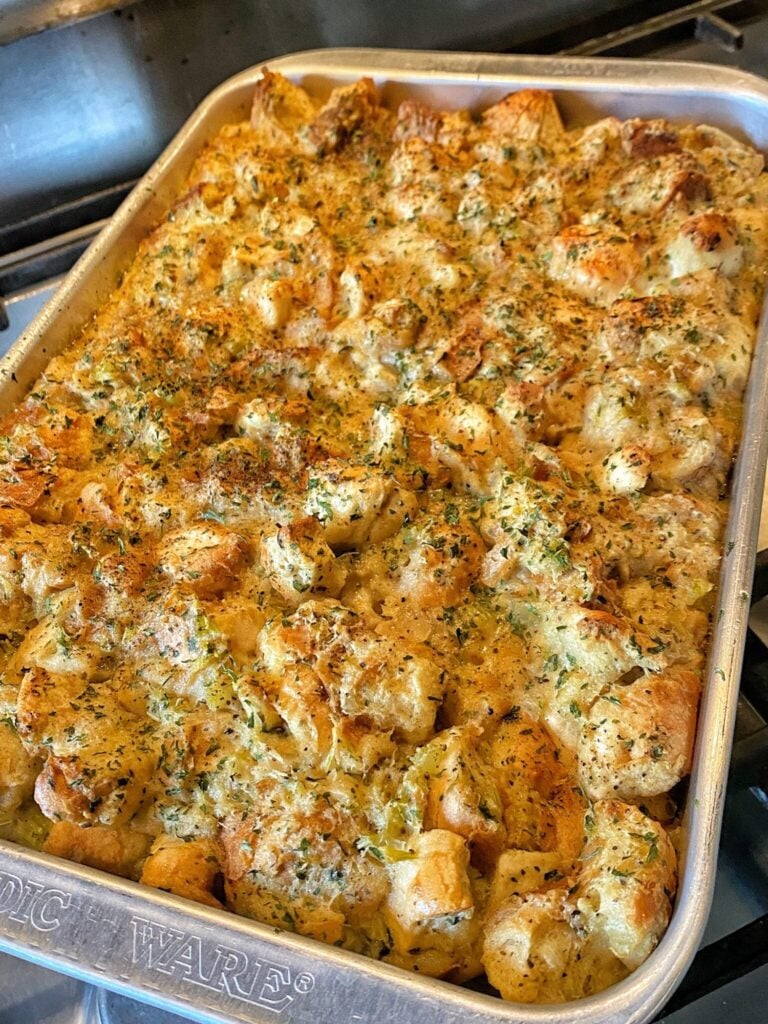
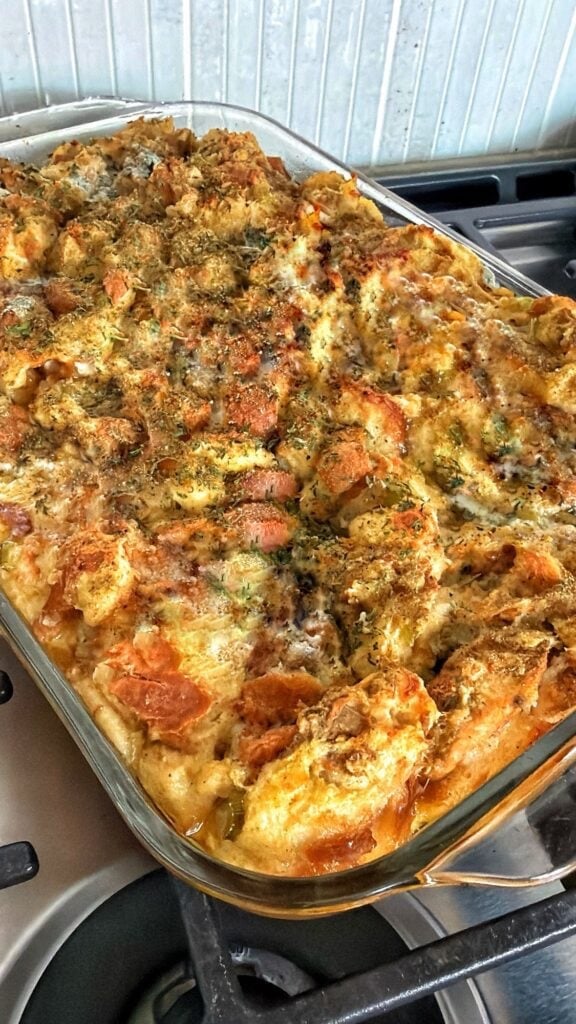
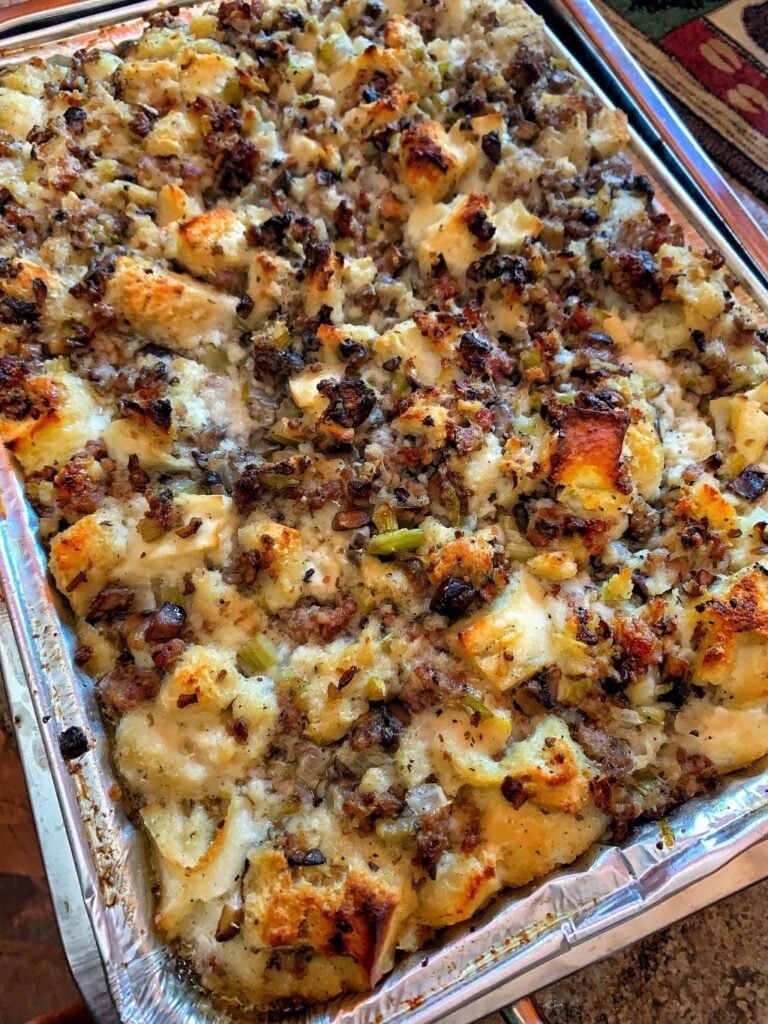
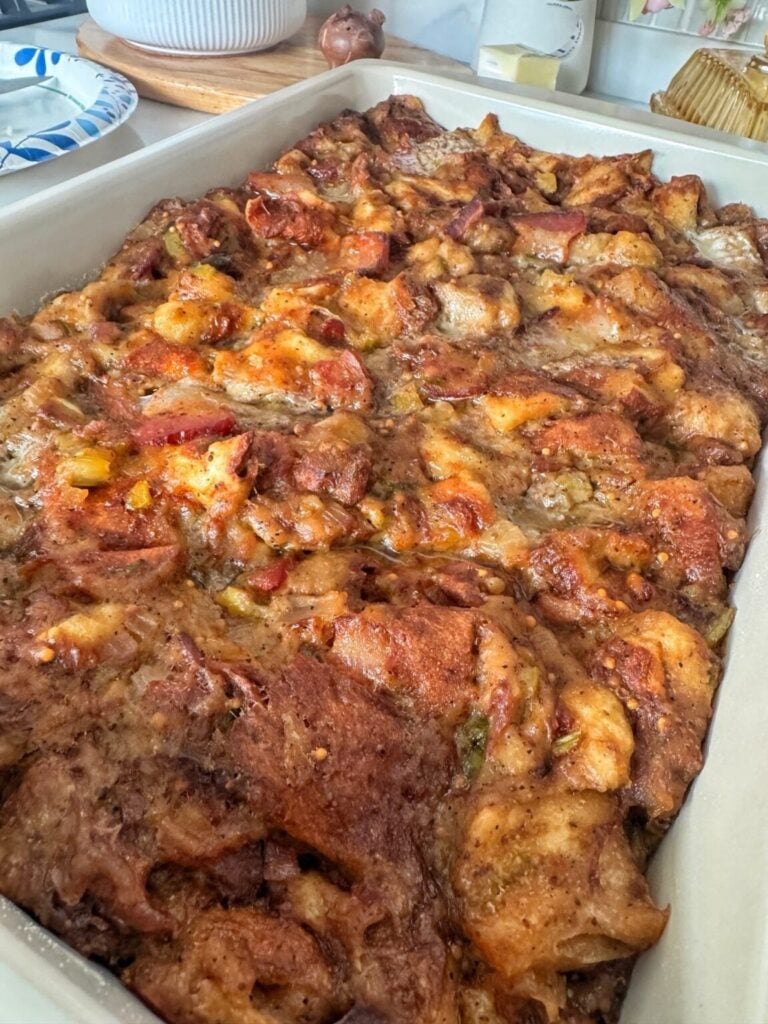
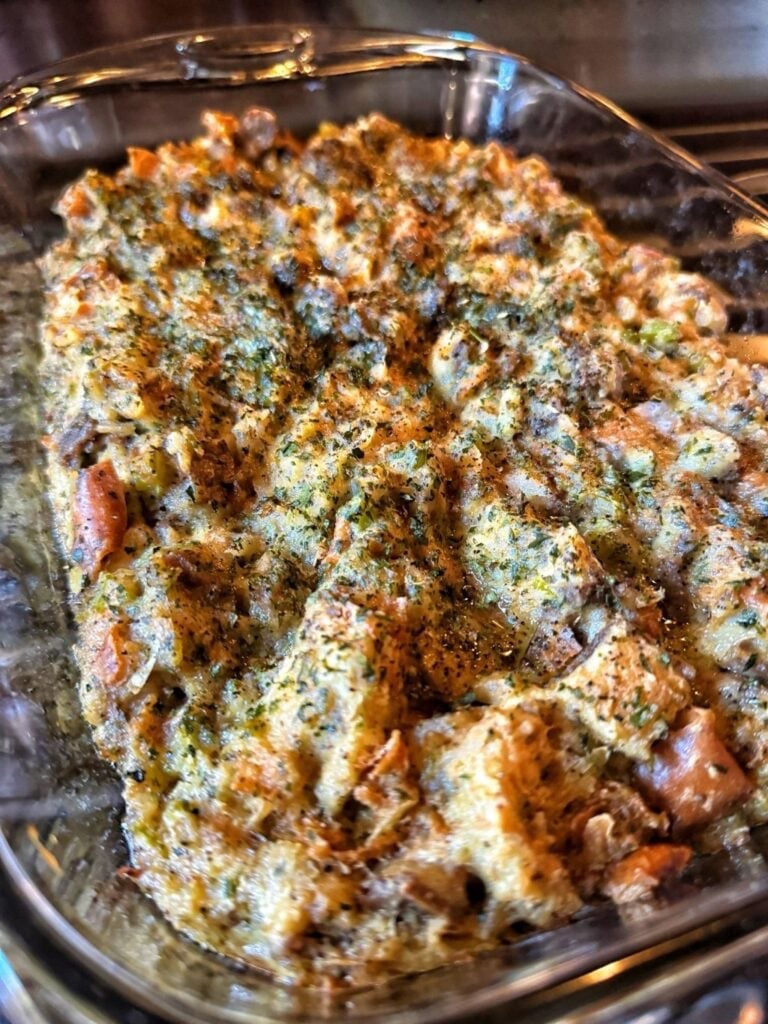
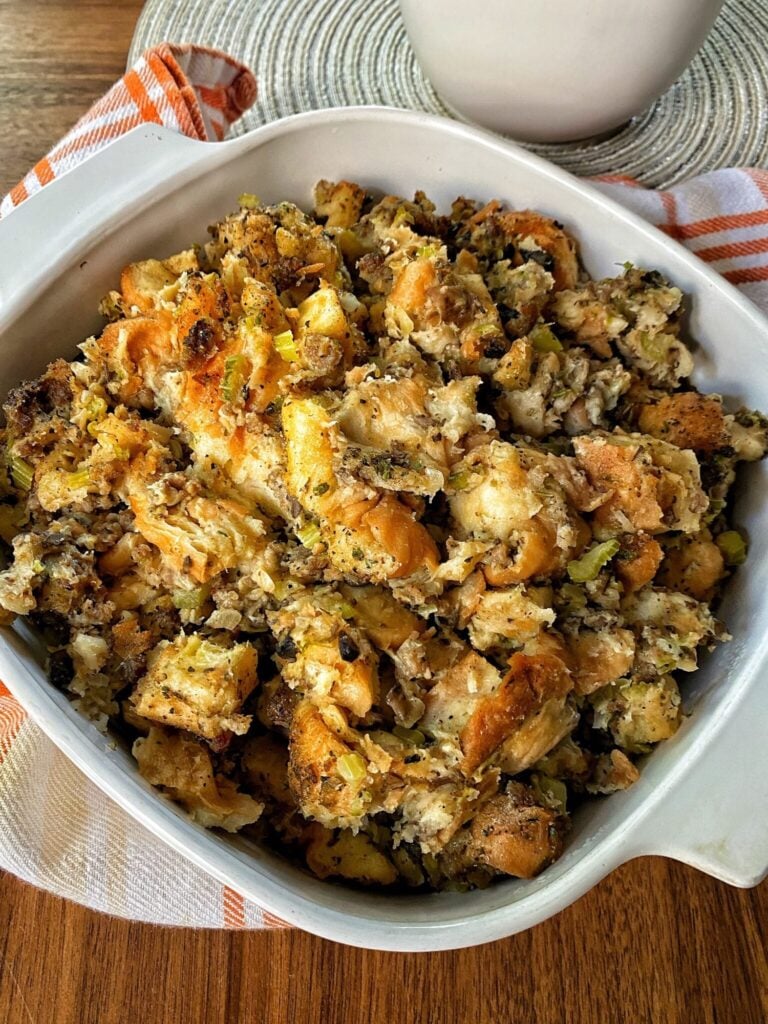
More Stuffing Recipes From The Tipsy Housewife
If this one is a little TOO Chicago for your Thanksgiving crowd, don’t worry.
I have stuffing options.
Frequently Asked Questions
Why is it called Chicago Style Stuffing?
This is my Chicago-inspired stuffing based on the flavors of a Chicago Italian beef sandwich.
It uses Italian sausage, giardiniera and beefy au jus to bring those flavors into a traditional bread stuffing.
Does this stuffing contain Italian beef?
No.
I use mild Italian sausage because it stays juicy while the stuffing bakes.
The Italian beef flavor comes primarily from the beefy au jus, Italian seasonings and giardiniera.
Can I use Italian beef instead?
You could experiment with adding some finely chopped Italian beef, but I prefer sausage because it stays moist and distributes throughout the stuffing more evenly.
What kind of sausage should I use?
I use mild Italian sausage.
Hot Italian sausage also works if you want a spicier stuffing.
What is giardiniera?
Giardiniera is a mixture of pickled vegetables and peppers.
Chicago-style giardiniera is commonly served on Italian beef sandwiches.
Should I use mild or hot giardiniera?
I use mild so the stuffing works for more people at a holiday table.
Use hot if your family prefers more heat.
Can I leave out the giardiniera?
Technically yes, but you’re removing one of the main ingredients that gives this stuffing its Chicago Italian beef personality.
If you don’t like giardiniera at all, one of my other stuffing recipes may be a better fit.
What kind of bread should I use?
I prefer chewy French bread.
A sturdy Italian bread can also work.
How much bread do I need?
The recipe uses three approximately 7-ounce mini French loaves, or roughly 21 ounces total.
That works out to approximately 14 cups or a little more depending on how you cube the bread.
Does the bread need to be stale?
No.
This recipe was developed using regular French bread.
Should I toast the bread first?
No.
I want the chewy French bread to absorb the flavorful sausage and au jus mixture.
Why does the stuffing look so wet before baking?
It’s supposed to be very moist.
The bread needs to absorb the beefy broth, butter and sausage juices.
It should be saturated but not sitting in a large puddle of liquid.
What if my stuffing is TOO wet?
Give the bread a little time to absorb the liquid first.
If there’s still a significant puddle of liquid at the bottom, fold in some additional bread cubes.
What if it’s too dry?
Add a little additional warm beef broth or prepared au jus.
Do this gradually.
What can I substitute for beef au jus bouillon?
Regular beef bouillon works.
Because brands vary significantly in saltiness, start with less and taste before adding more.
Do I have to use tomato powder?
No.
I recommend it for the extra savory flavor, but the stuffing will still work without it.
Can I use tomato bouillon instead?
Yes.
Tomato bouillon usually contains salt, so reduce the celery salt and possibly the beef bouillon to compensate.
Can I make this ahead?
Yes.
Prep the bread and cooked sausage-vegetable mixture ahead and refrigerate them separately.
Combine everything closer to baking time.
You can also completely bake the stuffing ahead and reheat it.
Can I stuff my turkey with this?
I recommend baking this recipe separately in a 9 x 13-inch casserole dish.
What temperature should stuffing reach?
The center should reach 165°F.
How long do leftovers last?
Properly refrigerated cooked stuffing should be used within 3 to 4 days.
Can I freeze it?
Yes.
I prefer freezing it after it has been completely baked and cooled.
Can I double the recipe?
Yes, but use two 9 x 13-inch baking dishes rather than piling a double batch into one extremely deep pan.
The stuffing will cook much more evenly.
Chicago on a Thanksgiving Plate
This recipe still makes me laugh because it came from such a simple thought.
I was eating an Italian beef sandwich and enjoying that bread soaked with beef juice and thought:
This should be stuffing.
And you know what?
I was right.
The Italian sausage keeps everything juicy.
The celery, onions and rosemary make it taste like Thanksgiving.
The giardiniera brings the Chicago.
And that beefy au jus gets soaked into every single piece of French bread.
It tastes familiar and completely different at the same time.
If you’re a Chicago person, you’ll get it immediately.
If you’re not?
Welcome.
Grab some giardiniera.
We’re happy to have you.
Chicago Style Stuffing Recipe

This Chicago Style Stuffing takes inspiration from a classic Chicago Italian beef sandwich. Chewy French bread absorbs a savory mixture of Italian sausage, celery, onions, mild giardiniera, herbs and beefy au jus before everything is baked until soft and savory inside with golden crispy edges on top.
Ingredients
- 3 mini French bread loaves, approximately 7 ounces each, about 21 ounces total
- 1 pound mild Italian sausage, casings removed if using links
- 1 large yellow onion, finely diced
- 4 celery stalks, finely diced
- 1 handful tender celery leaves, minced
- 1/4 cup finely minced mild giardiniera relish, plus more for topping if desired
- 2 teaspoons dried rosemary
- 1/2 tablespoon dried Italian seasoning
- 2 teaspoons celery seed
- 2 teaspoons tomato powder, optional but recommended
- 1/2 teaspoon celery salt, or to taste
- 1 1/2 teaspoons black pepper, or to taste
- 6 tablespoons butter
- 6 cups water
- Up to 2 heaping tablespoons beef au jus bouillon or regular beef bouillon, start with less and add to taste
- 2 large eggs
- 1 cup milk
- Additional butter for topping, optional
- Additional rosemary and Italian seasoning for topping, optional
- 1 cup milk
Instructions
- Heat the oven to 375°F.
- Cut the French bread into small bite-size cubes and place them in a very large mixing bowl.
- Melt the 6 tablespoons butter in a large skillet over medium-low heat.
- Add the diced onion, celery and minced celery leaves.
- Cook for approximately 10 to 15 minutes, stirring occasionally, until the vegetables are soft.
- Season the vegetables with the rosemary, Italian seasoning, celery seed, tomato powder, celery salt and black pepper.
- Add the Italian sausage.
- Break the sausage into a fine crumble as it cooks.
- Continue cooking until the sausage is completely cooked and nicely browned.
- Stir in the 1/4 cup minced giardiniera.
- Add some of the beef au jus bouillon or beef bouillon.
- Pour in the 6 cups water and stir well.
- Bring the mixture to a gentle simmer.
- Taste the liquid carefully and add additional bouillon if needed. Remember that the liquid will be absorbed by a large amount of unseasoned bread, but it should NOT taste excessively salty.
- Simmer for approximately 6 to 7 minutes to allow the flavors to combine. Do not boil away too much of the liquid.
- Carefully pour the hot sausage, vegetable and au jus mixture over the cubed French bread.
- Fold and mix thoroughly until the bread is evenly saturated.
- The bread should be VERY moist but not soupy. Give it a minute to absorb the liquid before deciding whether it needs adjusting.
- If a large amount of liquid remains pooled at the bottom after the bread has had time to absorb it, fold in a small amount of additional cubed French bread.
- Allow the bread mixture to cool slightly.
- In a separate bowl, whisk together the 2 eggs and 1 cup milk.
- Fold the egg and milk mixture thoroughly into the slightly cooled stuffing.
- Transfer the stuffing to a 9 x 13-inch baking dish and spread it into an even layer without packing it down too firmly.
- If desired, top with a few additional spoonfuls of giardiniera, a sprinkle of rosemary and Italian seasoning and a few small pats of butter.
- Bake uncovered for approximately 35 minutes, or until the top is golden, the edges are slightly crisp and the center is set.
- Check the center of the stuffing with an instant-read thermometer. It should reach 165°F.
- If the top becomes too brown before the center is ready, loosely cover the baking dish with foil and continue cooking.
- Remove from the oven and let the stuffing rest for 5 to 10 minutes.
- Add additional finely minced giardiniera over the top before serving, if desired.
Notes
- Bread: I use three approximately 7-ounce mini French bread loaves, or about 21 ounces total. This is roughly 14 cups or a little more after cubing, depending on the size of your cubes.
- Extra bread: Bread varies tremendously. Buying one small extra loaf gives you something to add if your particular bread doesn't absorb as much liquid.
- Do not intentionally dry the bread: This recipe was developed with regular chewy French bread. It does not need to be stale or toasted into croutons.
- Italian sausage: Mild Italian sausage is my preference. Hot Italian sausage can be used for more heat.
- Why sausage instead of Italian beef: Sausage stays juicy during baking and distributes throughout the stuffing. The beefy Italian-beef-inspired flavor comes from the au jus.
- Giardiniera: Finely minced relish-style mild giardiniera works best. Chunkier giardiniera can be drained of excess oil and minced more finely.
- Hot giardiniera: Use it if you prefer a spicier stuffing, or serve hot giardiniera alongside the finished dish.
- Tomato powder: Optional but recommended. If substituting salted tomato bouillon, reduce the celery salt and/or beef bouillon.
- Bouillon: Brands vary greatly in sodium. Start with less than the full amount, taste the prepared liquid and add more as needed.
- Moisture: The bread should be very moist and saturated before baking but should not have a large puddle of liquid sitting underneath it.
- Food safety: Bake until the center reaches 165°F.
- Make ahead: Bread and the cooked sausage-vegetable mixture can be prepared ahead and refrigerated separately. Combine with the egg and milk mixture closer to baking time.
- Bake ahead: The stuffing can also be fully baked, cooled, refrigerated and reheated.
- Leftovers: Refrigerate cooked stuffing within 2 hours and use within 3 to 4 days.
- Reheating: Reheat leftover stuffing to 165°F.
- Freezing: I prefer freezing the stuffing after it has been baked and cooled.
- Doubling: Use two 9 x 13-inch pans rather than one very deep pan.